
Accepting new patients · In-person & telehealth
How plans pay for psychiatric medication visits and TMS, what prior authorization involves, what you are likely to owe, and what to do if a claim is denied.
By the Blissz Psychiatry Clinical TeamMedically reviewed by Macbarbara Amaechi, PMHNP-BCPublished November 21, 20268 min read

Quick answer
Most health plans cover psychiatric medication management as an outpatient mental health benefit, usually without prior authorization, and many plans and Medicare also cover TMS therapy for depression once medical necessity criteria are met and prior authorization is approved. What you pay depends on your copay, coinsurance and deductible. Federal parity law requires plans that cover mental health to cover it on terms no more restrictive than medical care. Always verify benefits with your plan before starting treatment.
In this article
Medication management visits are billed much like other outpatient medical visits. Your first appointment is a psychiatric diagnostic evaluation. Follow-ups are billed as office visits based on their complexity, sometimes with an add-on code when psychotherapy is provided in the same visit.
For most people, that means medication management falls under the plan’s outpatient mental health or behavioral health benefit. You typically pay a copay per visit or a percentage of the allowed amount (coinsurance) once your deductible is met. Prior authorization for routine medication visits is uncommon, although some plans require a referral from a primary care provider.
The medication itself is covered separately, under your pharmacy benefit. If a prescription is not on your plan’s formulary, it may cost more or need its own approval, so tell your provider if a medication is too expensive.
Knowing the codes helps you ask your plan precise questions. These are the codes most often used for the services discussed here:
| Service | Common CPT codes | Prior authorization? |
|---|---|---|
| Initial psychiatric evaluation | 90791, 90792 | Rarely; some plans need a referral |
| Medication management follow-up | 99213, 99214 (plus 90833 if therapy is added) | Rarely |
| TMS initial session with mapping | 90867 | Almost always |
| TMS daily treatment sessions | 90868 | Covered under the same approval |
| TMS motor threshold re-check | 90869 | Covered under the same approval |
Your provider chooses codes based on the care actually delivered, so the exact codes for your visits may differ. Use the table as a starting point for your call with the plan.
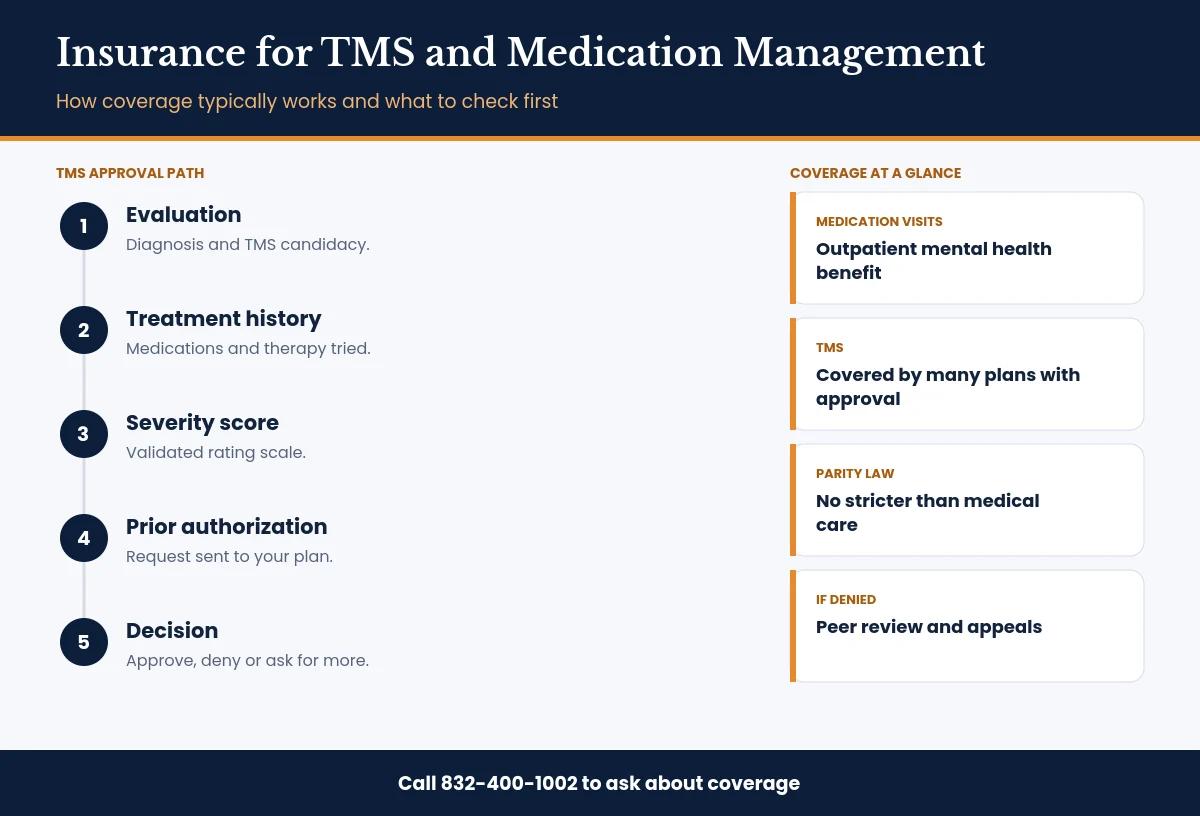
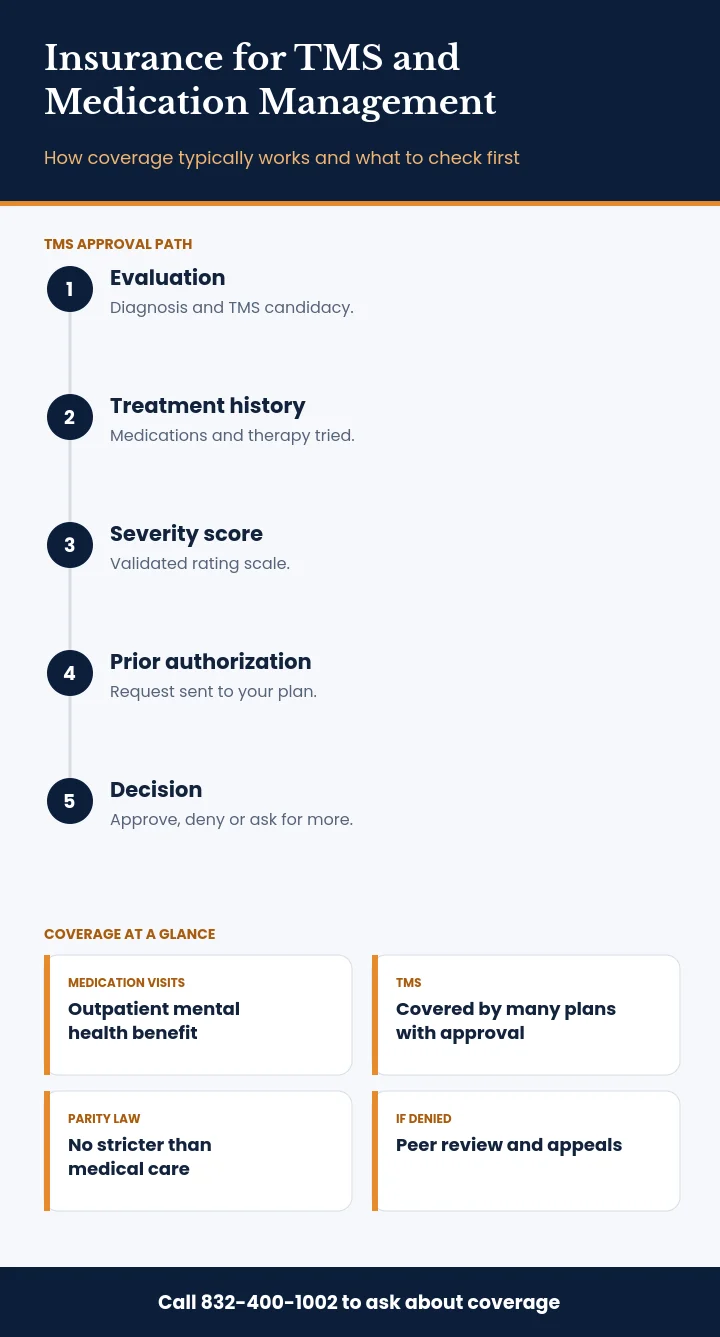
TMS has been FDA-cleared for major depressive disorder since 2008, and many commercial plans, Medicare and some Medicaid programs now cover it. Coverage is tied to medical necessity criteria, which commonly include:
Requirements differ between plans and can change when your benefits renew. Our article on who qualifies for TMS therapy explains the clinical side in detail.
Talk to a provider
We review your history, explain what your plan is likely to require and help gather records for prior authorization.
At Blissz Psychiatry, we help gather the information your plan needs and explain your coverage before treatment begins.
The Mental Health Parity and Addiction Equity Act requires most group health plans and individual market plans that cover mental health care to do so on terms no more restrictive than comparable medical and surgical care. Copays, visit limits and prior authorization rules for mental health services should not be stricter than those for similar medical services.
Parity does not mean every service is covered or free. It means the rules should be comparable. If your plan seems to treat mental health care far more strictly than other care, you can ask the plan for its criteria in writing and contact your state insurance department or the U.S. Department of Labor for help.

Denials are common, especially for TMS, and many are overturned. Work through these options:
Tip: Keep a folder with every letter, reference number and date of each call. It makes appeals far faster.
Talk to a provider
Call the office before your visit. We will tell you what to ask your plan and what payment looks like.
Call the member services number on your card and ask these questions. Write down the date, the name of the person you spoke with and a reference number.
Because a TMS course involves many sessions, small per-session costs add up. Knowing your out-of-pocket maximum often matters more than the per-visit copay, since many patients reach it during a full course.
Blissz Psychiatry accepts most major insurance plans and offers self-pay. Payment for insured and self-pay visits is due 24 hours before the appointment, and we accept major credit and debit cards. For current self-pay rates, call 832-400-1002.
Before your first visit, use our step-by-step guide to verifying your out-of-pocket costs, and see our insurance page and cost of care guide.
Medicare Part B can cover TMS for depression when local coverage criteria are met. Requirements vary by region, so your provider checks the specific criteria.
In most plans, yes. Follow-up visits are typically covered under outpatient mental health benefits, subject to your copay, coinsurance and deductible.
It varies by plan, from a few days to a few weeks. Complete records usually speed up the decision.
Your provider will discuss options, which may include another medication trial before TMS or an exception request if there is a clinical reason.
Self-pay is possible. Call the office for current rates and ask for a Good Faith Estimate before treatment starts.
No. Medications fall under your pharmacy benefit and formulary, which have separate rules and costs.
Your next step
Our office will help you understand coverage for evaluations, medication management and TMS. Call or book online.
About this article
Written by the Blissz Psychiatry Clinical Team and medically reviewed by Macbarbara Amaechi, PMHNP-BC, a board-certified psychiatric mental health nurse practitioner who provides psychiatric evaluations, medication management and supportive therapy in Sugar Land, TX, Seattle, WA, and by telehealth in Texas, Washington and Colorado. We check our articles against the sources listed below and update them when guidance changes.
Medical disclaimer: This article is for general education and is not a substitute for an individual evaluation, diagnosis or treatment. Do not start, stop or change a medication without talking to your prescriber. If you are in crisis, call or text 988, or call 911 in an emergency. Blissz Psychiatry is an outpatient practice and does not provide emergency services.
Keep Reading
 DepressionWho Qualifies for TMS Therapy for Depression?Who qualifies for TMS therapy for depression: medication history, safety screening and insurance criteria, explained. Call 832-400-1002.Nov 22, 2026 · 8 min read
 Patient ResourcesHow Do I Verify My Out-of-Pocket Costs Before an Appointment?A step-by-step script to verify your out-of-pocket costs before a psychiatric visit: deductibles, codes and Good Faith Estimates. Call 832-400-1002.Nov 20, 2026 · 7 min read
 Mental Health CareHow Is Medication Management Different From Therapy?How psychiatric medication management differs from therapy: who provides each, what visits look like and when you need one or both. Call 832-400-1002.Nov 21, 2026 · 8 min read
Related care at Blissz Psychiatry
Now accepting new patients
Tell us how to reach you, then pick your location to choose a time that works.
Prefer to talk? Call 832-400-1002
Step 1 of 2 · Your details
Share a few details and we will help you book with a board-certified provider. It takes about a minute, and no medical details are needed.
Step 2 of 2 · Select your schedule
Please select your schedule: choose a time on the secure booking calendar for the state you will be in during your visit.
Questions or trouble booking? Call 832-400-1002. In crisis? Call or text 988.
Book online
Choose the state you will be in at the time of your visit.