


Accepting new patients · In-person & telehealth

Home/Blog/Who Qualifies for TMS

Who Qualifies for TMS Therapy for Depression?

The clinical, safety and insurance criteria that decide whether transcranial magnetic stimulation is a good next step after antidepressants have not been enough.

By the Blissz Psychiatry Clinical TeamMedically reviewed by Macbarbara Amaechi, PMHNP-BCPublished November 22, 20268 min read

Woman sitting in an armchair with her head resting on her arm, looking exhausted
TMS is most often considered when depression has not lifted after antidepressant treatment.

Quick answer

Most people who qualify for TMS therapy are adults with major depressive disorder who have not improved enough with antidepressant medication, or could not tolerate its side effects, and who have no metal or implanted devices in or near the head. TMS has been FDA-cleared for depression since 2008. Insurance plans usually add their own requirements, such as a set number of failed antidepressant trials, a course of psychotherapy and a documented severity score. A consultation is the only reliable way to know whether you qualify.

What is TMS, and how does it help depression?

Transcranial magnetic stimulation (TMS) uses focused magnetic pulses, delivered through a coil placed against the scalp, to stimulate areas of the brain involved in mood regulation. Repeated over a series of sessions, the stimulation is thought to strengthen communication in brain networks that are underactive in depression.

TMS is non-invasive. You stay awake in a comfortable chair, there is no anesthesia, and you can drive yourself home or back to work afterward. A typical course is about five sessions a week for roughly six weeks, followed by a short taper. Session length depends on the protocol and ranges from a few minutes to about 40 minutes.

It is not a first-line treatment. TMS is usually considered after medication and therapy have been tried, which is why the qualification questions focus so heavily on your treatment history.

What are the clinical criteria for TMS?

A provider weighs several factors before recommending TMS. You are more likely to be a good candidate if you:

  • Have a diagnosis of major depressive disorder, confirmed by a psychiatric evaluation
  • Have tried one or more antidepressants at an adequate dose and duration without enough improvement
  • Could not stay on antidepressants because of side effects such as weight gain, sexual side effects, drowsiness or emotional numbness
  • Have had depression return after periods of improvement
  • Want a treatment that does not add another daily medication

Professional guidance generally supports TMS for moderate to severe depression after at least one failed antidepressant. Insurance criteria are often stricter, which we cover below.

Some situations need more discussion: depression within bipolar disorder, depression with psychotic symptoms, active substance use, or a recent suicide attempt. These do not automatically rule TMS out, but they can change whether it is the right choice or the right time.

Age also matters. TMS for depression has long been cleared for adults, and some devices have since received clearance for older teenagers. At Blissz Psychiatry, call the office to confirm age eligibility before booking a TMS consultation.

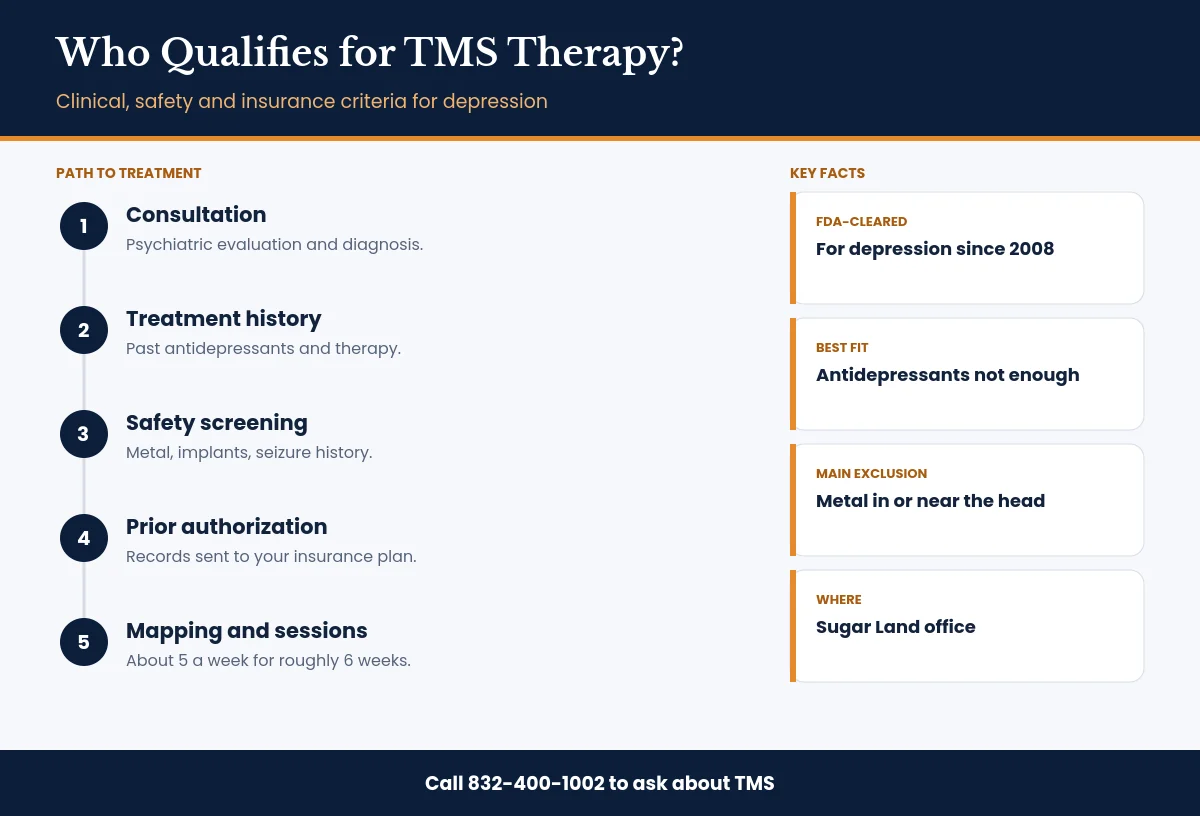
Infographic outlining TMS therapy eligibility for depression, from consultation and safety screening to prior authorization and treatment sessions
Who qualifies for TMS therapy for depression: the five steps from consultation to treatment, plus key facts on clearance, candidates and exclusions.
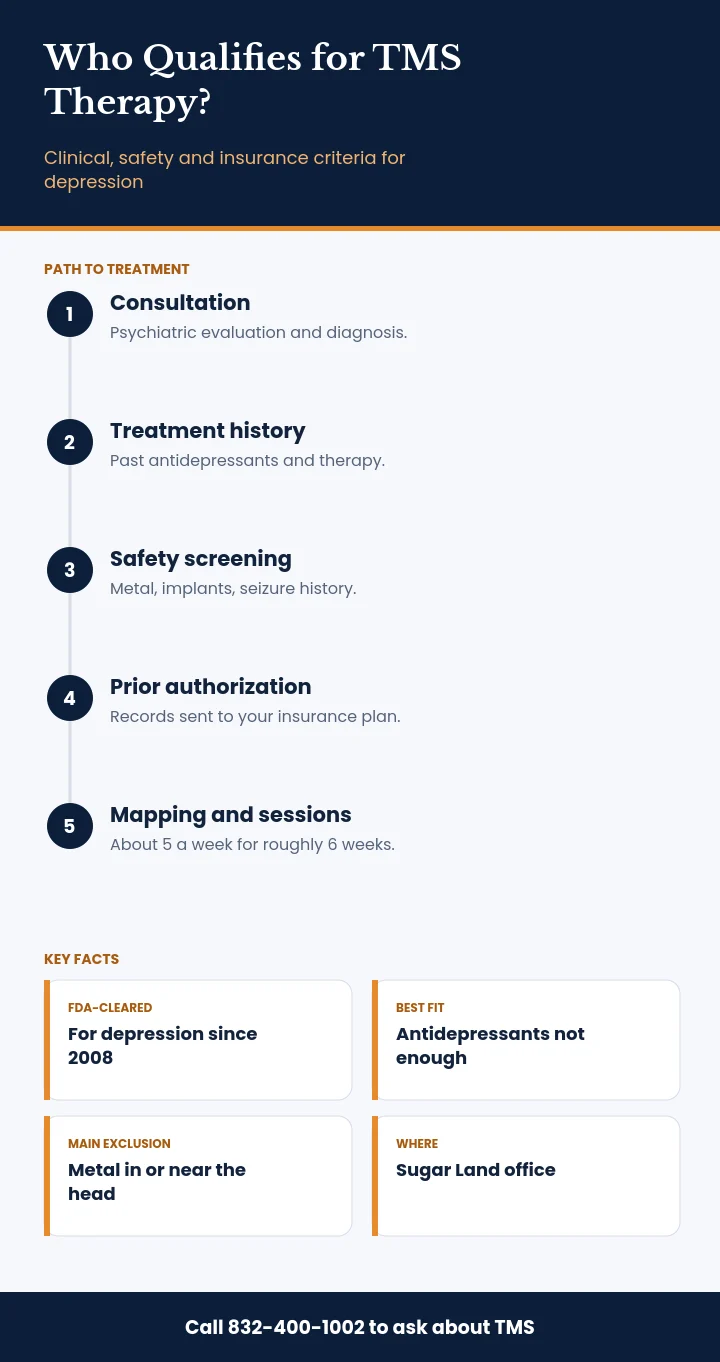
Infographic outlining TMS therapy eligibility for depression, from consultation and safety screening to prior authorization and treatment sessions
Who qualifies for TMS therapy for depression: the five steps from consultation to treatment, plus key facts on clearance, candidates and exclusions.

Who should not have TMS?

Safety screening is non-negotiable. The main exclusion is ferromagnetic metal in or near the head, because the magnetic field can move or heat it. Examples include:

  • Aneurysm clips or coils
  • Metal plates, screws or fragments in the skull
  • Cochlear implants
  • Deep brain stimulators, vagus nerve stimulators or other implanted electronic devices near the head or neck
  • Certain facial tattoos with metallic ink

Standard dental fillings and braces are generally not a problem. A personal history of seizures, a recent head injury or a neurological condition requires careful review, because seizures are a rare but serious risk of TMS. Pregnancy is not an automatic exclusion but is discussed individually.

When to seek care sooner: TMS takes weeks to work and is not an emergency treatment. If you are thinking about ending your life, call or text 988 now, or call 911 or go to the nearest emergency room.

Talk to a provider

Not sure whether you qualify for TMS?

A short consultation reviews your medication history, safety screening and insurance criteria so you know where you stand.

What do insurance plans usually require?

Many commercial plans and Medicare cover TMS for depression, but each plan sets its own medical necessity criteria. The most common requirements are:

Typical insurance requirements
RequirementWhat plans often ask for
DiagnosisMajor depressive disorder, documented in your records
Medication trialsUsually two to four antidepressants that failed or were not tolerated, sometimes from different classes
PsychotherapyA trial of evidence-based therapy, often during the current episode
SeverityA score on a validated scale, such as the PHQ-9, showing moderate to severe depression
SafetyNo contraindications, such as metal implants near the head

Because requirements vary so much, records matter. Medication names, doses, dates and reasons for stopping are what insurers review. Our article on insurance coverage for TMS and medication management explains prior authorization in more detail.

How does the TMS qualification process work?

  1. Book a consultation. Call 832-400-1002. If you are new to Blissz Psychiatry, you start with a psychiatric evaluation.
  2. Review your treatment history. We go through past antidepressants, doses, how long you took each one and why you stopped, plus any therapy you have had.
  3. Complete safety screening. We ask about implants, metal, seizures, head injuries and medications that can lower the seizure threshold.
  4. Measure your symptoms. A standardized rating scale documents your current severity and gives a baseline to track progress.
  5. Request prior authorization. We help gather the information your insurance plan needs and submit the request.
  6. Start treatment. Your first session includes mapping, which finds your motor threshold and the exact treatment location. Daily sessions follow.

Talk to a provider

Bring your medication history, and we will do the rest

We help gather the records your plan needs for prior authorization and explain your options before treatment begins.

What results can you expect, and what are the side effects?

Many patients begin noticing changes in sleep, energy or mood within two to four weeks, although the timeline differs for each person and some people respond later in the course. TMS can be combined with medication management and therapy, and many patients continue their antidepressant during treatment.

The most common side effects are scalp discomfort at the treatment site and mild headaches, which usually ease after the first week. Because TMS involves no anesthesia, there is no recovery time and no memory loss of the kind associated with electroconvulsive therapy. Seizures are rare, and the screening process is designed to reduce that risk further.

Young woman sitting with her knees pulled to her chest, looking down
Depression that keeps returning despite treatment is one of the most common reasons people ask about TMS.

Where can you get TMS near Sugar Land and Houston?

Blissz Psychiatry offers FDA-cleared TMS therapy at our Sugar Land office, 12930 Dairy Ashford Rd, Suite 701, off US-59 (I-69). Patients come from Sugar Land, Missouri City, Stafford, Richmond, Katy and southwest Houston. Because the course involves several visits a week, a location close to home or work makes the schedule easier to keep.

See our TMS therapy page for Sugar Land or our page for Houston patients for details.

Key takeaways

  • TMS is FDA-cleared for major depressive disorder and is usually considered after antidepressants have not worked well enough.
  • The main safety exclusion is ferromagnetic metal or implanted devices in or near the head.
  • Insurance plans often require two to four failed medication trials, a psychotherapy trial and a severity score.
  • A typical course is about five sessions a week for roughly six weeks, with no anesthesia and no downtime.
  • A consultation that reviews your records is the only reliable way to know whether you qualify.

Frequently asked questions

Clinically, TMS can be considered after one or more antidepressants have not helped enough. Many insurance plans require two to four failed trials, so the answer depends on your plan.

Often, yes. Many patients continue their medication during TMS. Your provider will review your medications as part of safety screening.

Most people feel a tapping sensation and some scalp discomfort during early sessions. Mild headaches are common at first and usually ease within the first week.

Yes. TMS does not use anesthesia or sedation, so you can drive yourself and return to work or school the same day.

Certain devices have FDA clearance for other uses, such as obsessive-compulsive disorder. Ask your provider which uses apply to the treatment offered.

Not everyone responds. Your provider will track your progress with rating scales and discuss next steps, which may include medication changes or other treatments.

Your next step

Find out whether TMS is your next step

If antidepressants have not given you your life back, a TMS consultation can clarify your options. Call our Sugar Land office or book online.

About this article

Written by the Blissz Psychiatry Clinical Team and medically reviewed by Macbarbara Amaechi, PMHNP-BC, a board-certified psychiatric mental health nurse practitioner who provides psychiatric evaluations, medication management and supportive therapy in Sugar Land, TX, Seattle, WA, and by telehealth in Texas, Washington and Colorado. We check our articles against the sources listed below and update them when guidance changes.

Sources and further reading

Medical disclaimer: This article is for general education and is not a substitute for an individual evaluation, diagnosis or treatment. Do not start, stop or change a medication without talking to your prescriber. If you are in crisis, call or text 988, or call 911 in an emergency. Blissz Psychiatry is an outpatient practice and does not provide emergency services.

Now accepting new patients

Start care with a board-certified provider

Tell us how to reach you, then pick your location to choose a time that works.

Prefer to talk? Call 832-400-1002

Step 1 of 2 · Your details

Need a Consultation or Appointment?

Share a few details and we will help you book with a board-certified provider. It takes about a minute, and no medical details are needed.

Step 2 of 2 · Select your schedule

Many thanks for your interest!

Please select your schedule: choose a time on the secure booking calendar for the state you will be in during your visit.

Questions or trouble booking? Call 832-400-1002. In crisis? Call or text 988.

Call us832-400-1002