
Accepting new patients · In-person & telehealth
PTSD treatment at Blissz Psychiatry is trauma-informed from the first visit. After a careful psychiatric evaluation, we build a plan that may include trauma-focused psychotherapy, medication to ease symptoms such as anxiety, low mood and nightmares, and support for sleep and daily functioning. You never have to share more about your trauma than you are ready to. Care is led by Macbarbara Amaechi, APRN, PMHNP-BC, by secure video anywhere in Houston and Texas, or in person at our Sugar Land office at 12930 Dairy Ashford Rd, Suite 701.

At a Glance
Who we help, how the first visit works and what treatment can include.
Post-traumatic stress disorder (PTSD) can develop after experiencing or witnessing a frightening, dangerous or life-threatening event, such as an assault, accident, combat, disaster or the sudden loss of a loved one. According to the National Institute of Mental Health (NIMH), most people have some stress reactions after trauma, and many recover naturally. When symptoms last more than a month and interfere with life, PTSD may be the cause.
PTSD is a normal brain and body response to an abnormal experience, not a sign of weakness. It is treatable, even years after the trauma, and many people see meaningful improvement with the right combination of therapy and medication.
Complex trauma from long-term or repeated experiences can also affect relationships, self-image and emotional regulation.
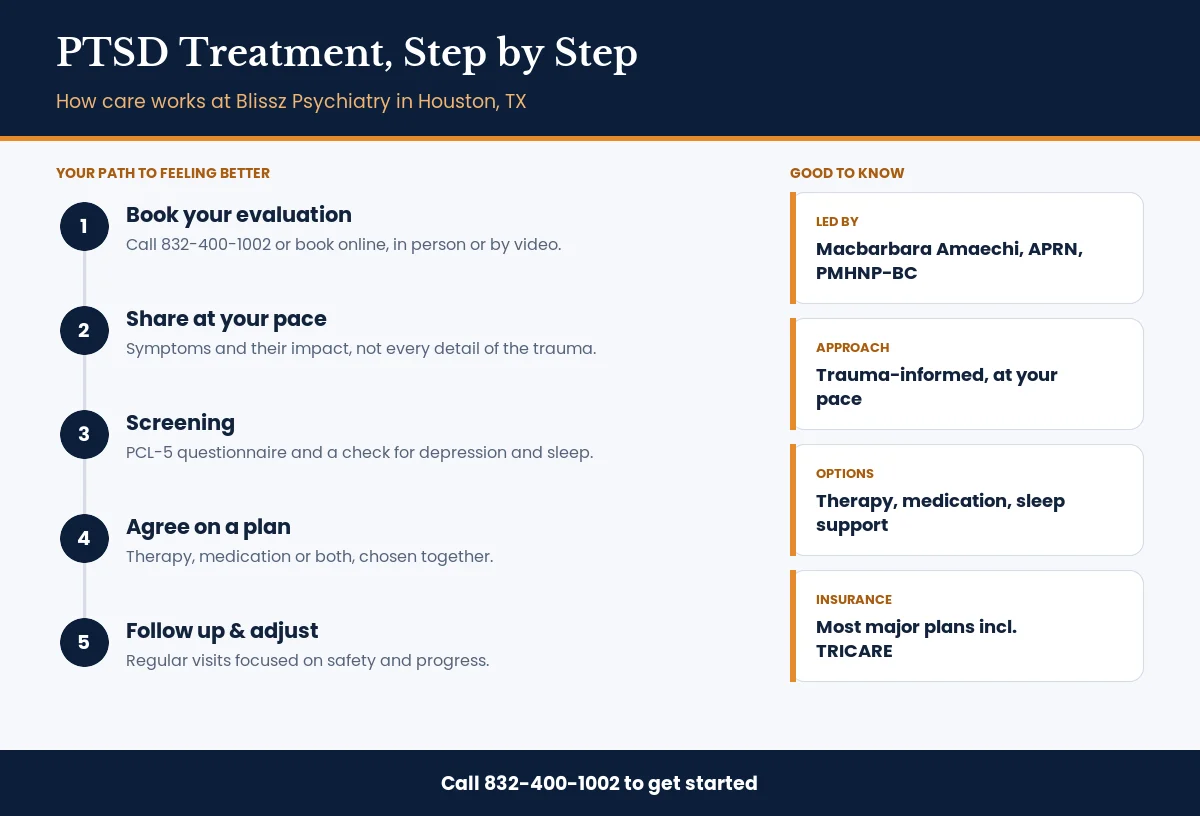
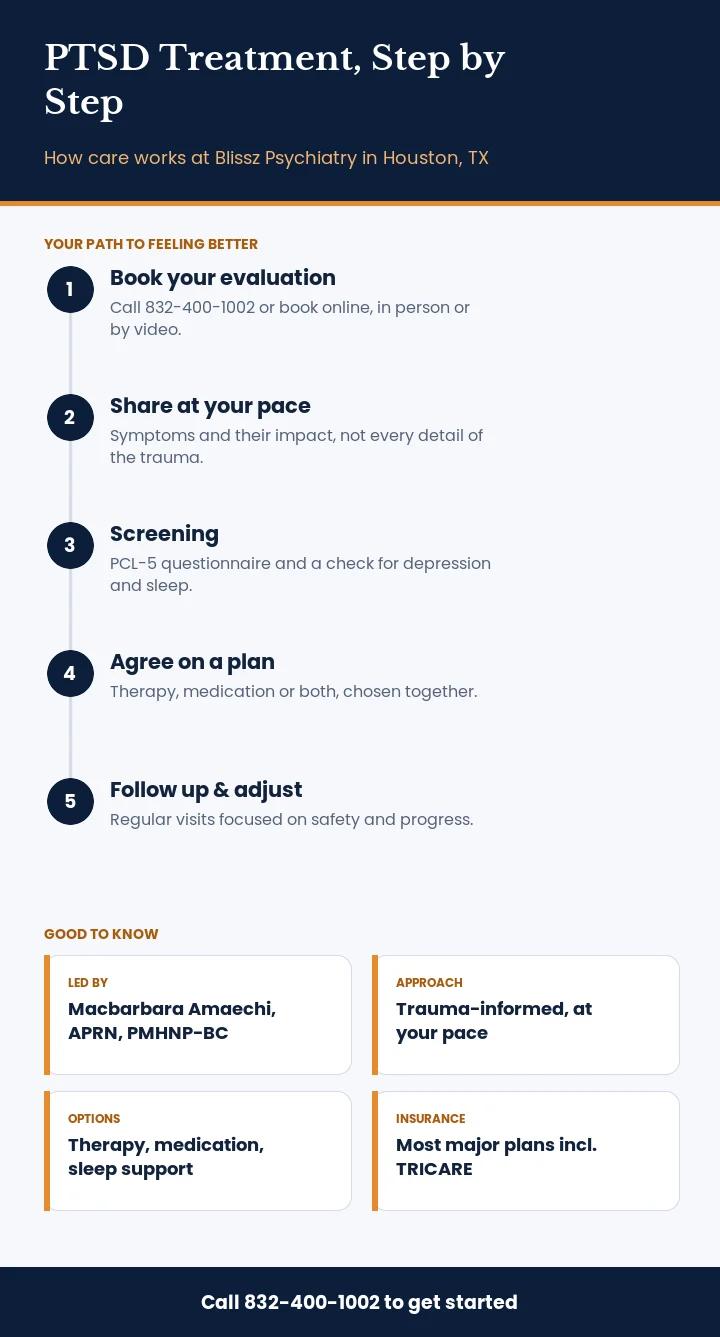
Your first visit is a full psychiatric evaluation done in a trauma-informed way. We focus on your symptoms and how they affect sleep, work and relationships, not on making you retell painful details. The PTSD Checklist (PCL-5) helps measure symptoms and track progress.
We also look for conditions that often occur with PTSD, including depression, anxiety, insomnia, chronic pain and substance use, and review your medical history and medications. You leave with an explanation of what we see and a plan you agreed to.
Step by Step
Here is what to expect, step by step.
Book an evaluation by secure video anywhere in Texas or at our Sugar Land office. Most major insurance plans are accepted.
Treatment follows clinical guidance, including the American Psychiatric Association (APA) and the VA/DoD clinical practice guideline for PTSD:

Most Houston patients choose HIPAA-compliant video visits, which cover the same evaluation and follow-up care as an office visit, as long as you are physically in Texas at the time. In-person visits are available at our Sugar Land office, a short drive from southwest Houston.
Many trauma survivors find video visits easier at first, because they can join from a space where they feel safe. We accept TRICARE (Humana Military) and work with veterans and military families.
Trauma-Related Conditions
Trauma affects people in different ways. These are the patterns we see most.
| Condition | What it can look like | Common treatment approach |
|---|---|---|
| PTSD | Flashbacks, nightmares, avoidance and hyperarousal lasting more than a month after trauma | Trauma-focused therapy, SSRI or SNRI medication |
| Complex trauma | Long-term or repeated trauma affecting emotions, relationships and self-image | Phased therapy, stabilization and medication support |
| Acute stress reactions | Intense symptoms in the first month after a traumatic event | Support, sleep care and close follow-up |
| Trauma with depression or substance use | Low mood, numbness or drinking to cope alongside PTSD | Integrated plan that treats both |
| Trauma-related nightmares and insomnia | Repeated nightmares and fear of sleep | Sleep-focused treatment and medication when appropriate |
Medication
Medication supports therapy and daily functioning.
Clinical guidelines, including the VA/DoD guideline, advise against benzodiazepines for PTSD because they do not treat core symptoms, can interfere with trauma-focused therapy and carry risks of dependence.
Our approach focuses on treatments shown to help PTSD over the long term, adjusted at regular follow-up visits.
Your Provider
Care at Blissz Psychiatry is led by Macbarbara Amaechi, PMHNP-BC, a board-certified psychiatric mental health nurse practitioner. Her clinical work centers on three things: thorough psychiatric evaluations, careful medication management and supportive therapy. She combines psychopharmacology with psychotherapy-informed care, explains options in plain language and makes treatment decisions with you, not for you.
Blissz Psychiatry holds a verified provider profile on Psychology Today, and the practice sees patients in person in Sugar Land, TX and Seattle, WA, and by secure video for patients located in Texas, Washington or Colorado.
Provider credentials

Insurance & Access
Plans and benefits vary. Call the number on your insurance card to confirm outpatient mental health coverage, or call us at 832-400-1002 and we will help you check. Self-pay is also available; ask our office for current rates.
Sugar Land office: 12930 Dairy Ashford Rd, Suite 701, Sugar Land, TX 77478, serving Sugar Land, Missouri City, Stafford, Richmond, Rosenberg, Katy and Houston. HIPAA-compliant video visits are available anywhere in Texas, Washington and Colorado.
Booking: Call 832-400-1002 or book online and choose the state you will be in during your visit. Ask our office about the next available new-patient appointment.
Payment: Due 24 hours before your visit; major credit and debit cards accepted.
In crisis? Call or text 988 (Suicide & Crisis Lifeline), or call 911. We are an outpatient practice and do not provide emergency care.
FAQ
We work with most major insurance plans, including Aetna, Blue Cross Blue Shield, UnitedHealthcare, Cigna, Anthem, Humana Military (TRICARE), Molina, AmeriHealth, Kaiser Permanente, Medicare and Medicaid. Coverage depends on your specific plan, deductible and network status. Call the member services number on your insurance card to confirm outpatient mental health benefits, or call our office at 832-400-1002 and we will help you check before your first visit. Self-pay is also available.
No. In your evaluation we focus on your symptoms and how they affect your life, and you decide how much to share. Trauma-focused therapies do involve processing the trauma, but at a pace you agree to with a trained therapist. Feeling safe and in control is part of effective treatment, not an obstacle to it.
Yes. PTSD can improve with treatment whether the trauma happened months or decades ago. Trauma-focused psychotherapies such as CPT, PE and EMDR, along with medication such as sertraline or paroxetine, help many people reduce symptoms significantly. It is never too late to start.
Yes. We accept TRICARE through Humana Military, along with most major commercial plans, Medicare and Medicaid. Benefits vary by plan, so check your outpatient mental health coverage before your first visit, or call our office at 832-400-1002 and we will help you confirm it.
Trauma-related nightmares often improve as PTSD is treated. Targeted options include imagery rehearsal therapy, sleep-focused cognitive behavioral therapy and, in some cases, medication such as prazosin. We also look at sleep habits, alcohol and other factors that make nightmares worse.
Yes. Evaluations and follow-up visits are available by HIPAA-compliant video when you are physically located in Texas at the time of the appointment. You will need a private space, a stable internet connection and a device with a camera. Prescriptions are sent electronically to your preferred pharmacy. Controlled medications follow additional federal and state rules, which our office will explain before your visit.
Availability changes week to week, so the fastest way to find the next open new-patient appointment is to call 832-400-1002 or check our online booking calendar for Texas. Video visits sometimes have earlier openings than in-person appointments. If you are in crisis, do not wait for a scheduled visit: call or text 988, call 911, or go to the nearest emergency room.
Have a question we did not answer here? Our office will walk you through it.
Location & Service Area
Houston patients have two options. Secure video visits work from anywhere in Houston or elsewhere in Texas, with no commute. For in-person care, our office is at 12930 Dairy Ashford Rd, Suite 701, Sugar Land, TX 77478, reached from Houston via US-59 (I-69) or the Westpark Tollway.
We regularly see patients from Alief, Westchase, Sharpstown, Bellaire, Meyerland, Mission Bend and the Energy Corridor. Many start with a video evaluation and come to the office only when it is useful.
Blissz Psychiatry
12930 Dairy Ashford Rd, Suite 701
Sugar Land, TX 77478
Phone: 832-400-1002 · Fax: 832-410-3353
PTSD is treatable. Call our office or book online, in person in Sugar Land or by secure video anywhere in Texas.
Now accepting new patients
Tell us how to reach you, then pick your location to choose a time that works.
Prefer to talk? Call 832-400-1002
Step 1 of 2 · Your details
Share a few details and we will help you book with a board-certified provider. It takes about a minute, and no medical details are needed.
Step 2 of 2 · Select your schedule
Please select your schedule: choose a time on the secure booking calendar for the state you will be in during your visit.
Questions or trouble booking? Call 832-400-1002. In crisis? Call or text 988.
Book online
Choose the state you will be in at the time of your visit.