
Accepting new patients · In-person & telehealth
Bipolar disorder care at Blissz Psychiatry starts with a careful diagnostic evaluation, because bipolar disorder is often mistaken for depression, anxiety or ADHD. Treatment usually centers on mood-stabilizing medication with regular monitoring, plus education, sleep and routine support, and therapy. We treat bipolar I, bipolar II and cyclothymic disorder. Care is led by Macbarbara Amaechi, APRN, PMHNP-BC, by secure video anywhere in Houston and Texas, or in person at our Sugar Land office at 12930 Dairy Ashford Rd, Suite 701.

At a Glance
Who we help, how the first visit works and what treatment can include.
Bipolar disorder is a mood condition with episodes of depression and episodes of abnormally elevated or irritable mood, called mania or, in a milder form, hypomania. Between episodes, many people feel well. According to the National Institute of Mental Health (NIMH), bipolar disorder is a lifelong condition, but with consistent treatment most people manage it well and lead full lives.
Because people usually seek help during depression, bipolar disorder is often first diagnosed as major depression. The difference matters: antidepressants on their own can trigger mania or rapid mood cycling in some people with bipolar disorder.
During mania or hypomania:
During depression: low mood, loss of interest, fatigue, sleep changes and hopelessness. If you are having thoughts of suicide, call or text 988 now, or call 911.

Your first visit is a full psychiatric evaluation. We build a detailed timeline of your mood, sleep, energy and behavior, often with input from a family member or partner, because hypomania can be easy to miss from the inside. Questionnaires such as the Mood Disorder Questionnaire (MDQ) support the interview.
We also review medical causes and medications that can affect mood, such as thyroid problems, steroids, stimulants and substance use, and may recommend lab work. Diagnosis sometimes takes more than one visit, and that care is worth it, because the diagnosis shapes every treatment decision that follows.
Step by Step
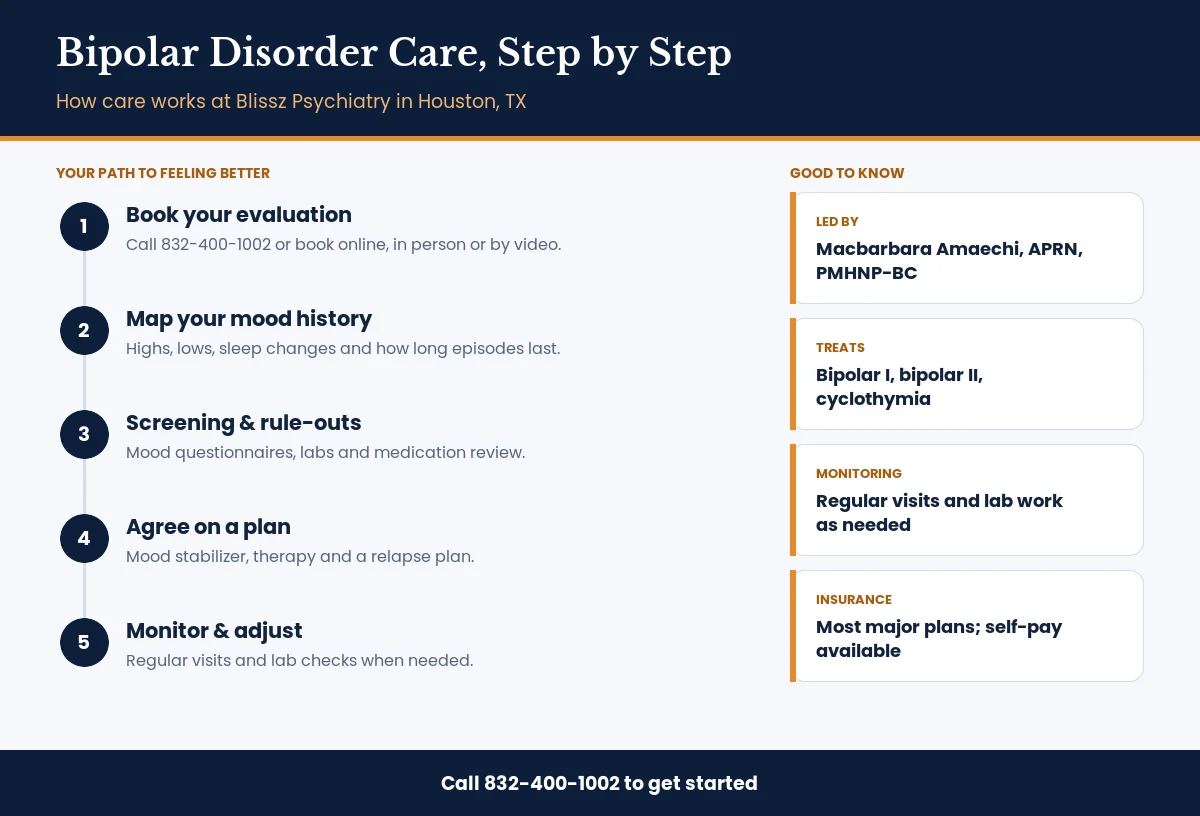
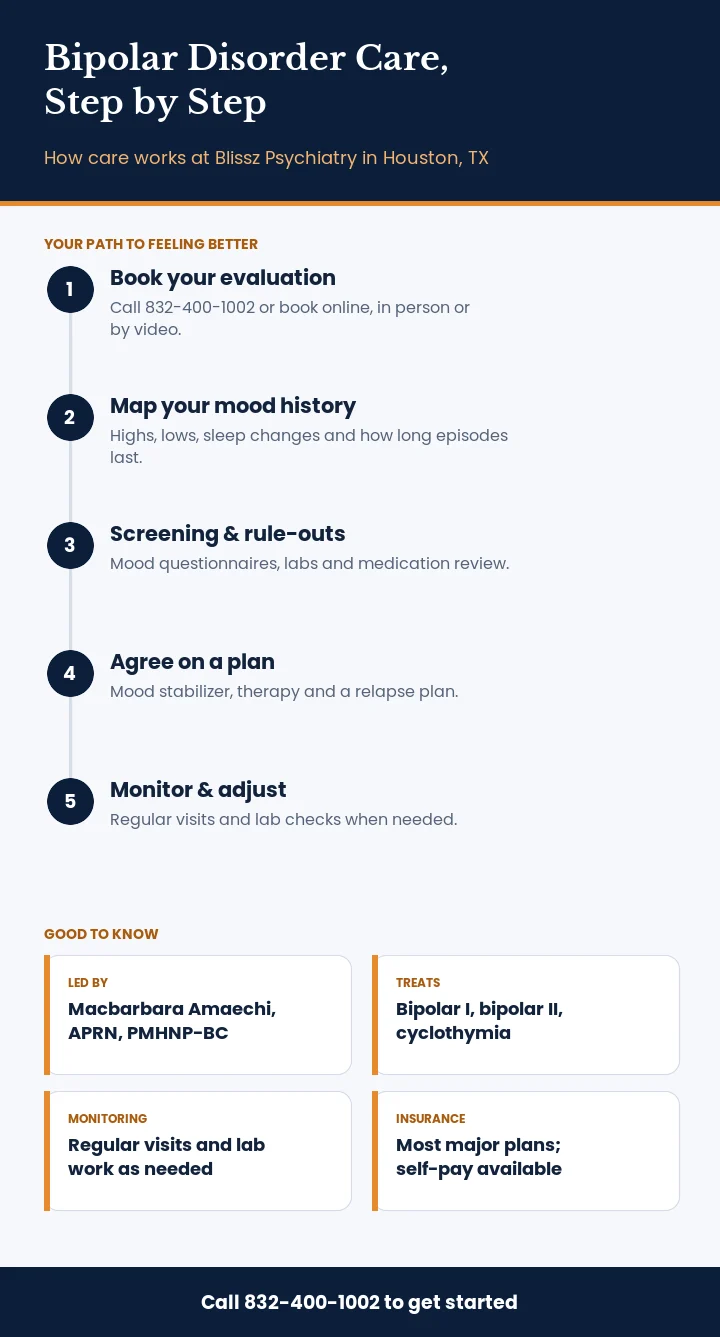
Here is what to expect, step by step.
Book an evaluation by secure video anywhere in Texas or at our Sugar Land office. Most major insurance plans are accepted.
Treatment follows clinical guidance, including the American Psychiatric Association (APA), and focuses on stability over time:

Most Houston patients choose HIPAA-compliant video visits, which cover the same evaluation and follow-up care as an office visit, as long as you are physically in Texas at the time. In-person visits are available at our Sugar Land office, a short drive from southwest Houston.
Some bipolar medications need periodic blood tests, such as lithium levels or kidney and thyroid checks. We coordinate lab work at a location convenient for you.
Types of Bipolar Disorder
The type of bipolar disorder guides the treatment plan.
| Type | What it involves | Common treatment approach |
|---|---|---|
| Bipolar I disorder | At least one manic episode, lasting a week or more or requiring hospital care; depressive episodes are common | Mood stabilizer or atypical antipsychotic, relapse plan |
| Bipolar II disorder | Episodes of hypomania and major depression, without full mania | Mood stabilizer such as lamotrigine or an atypical antipsychotic |
| Cyclothymic disorder | Two or more years of milder ups and downs that do not meet full episode criteria | Monitoring, routine, therapy and medication when needed |
| Bipolar disorder with anxiety or ADHD | Mood episodes alongside anxiety or attention problems | Stabilize mood first, then treat co-occurring conditions |
Medication
Medication is chosen carefully, with safety checks built in.
Antidepressants used on their own can trigger mania or faster mood cycling in some people with bipolar disorder. If an antidepressant is ever considered, it is combined with a mood stabilizer and monitored closely.
We review weight, blood sugar, cholesterol and other labs as needed, depending on the medication, and adjust the plan with you.
Your Provider
Care at Blissz Psychiatry is led by Macbarbara Amaechi, PMHNP-BC, a board-certified psychiatric mental health nurse practitioner. Her clinical work centers on three things: thorough psychiatric evaluations, careful medication management and supportive therapy. She combines psychopharmacology with psychotherapy-informed care, explains options in plain language and makes treatment decisions with you, not for you.
Blissz Psychiatry holds a verified provider profile on Psychology Today, and the practice sees patients in person in Sugar Land, TX and Seattle, WA, and by secure video for patients located in Texas, Washington or Colorado.
Provider credentials

Insurance & Access
Plans and benefits vary. Call the number on your insurance card to confirm outpatient mental health coverage, or call us at 832-400-1002 and we will help you check. Self-pay is also available; ask our office for current rates.
Sugar Land office: 12930 Dairy Ashford Rd, Suite 701, Sugar Land, TX 77478, serving Sugar Land, Missouri City, Stafford, Richmond, Rosenberg, Katy and Houston. HIPAA-compliant video visits are available anywhere in Texas, Washington and Colorado.
Booking: Call 832-400-1002 or book online and choose the state you will be in during your visit. Ask our office about the next available new-patient appointment.
Payment: Due 24 hours before your visit; major credit and debit cards accepted.
In crisis? Call or text 988 (Suicide & Crisis Lifeline), or call 911. We are an outpatient practice and do not provide emergency care.
FAQ
We work with most major insurance plans, including Aetna, Blue Cross Blue Shield, UnitedHealthcare, Cigna, Anthem, Humana Military (TRICARE), Molina, AmeriHealth, Kaiser Permanente, Medicare and Medicaid. Coverage depends on your specific plan, deductible and network status. Call the member services number on your insurance card to confirm outpatient mental health benefits, or call our office at 832-400-1002 and we will help you check before your first visit. Self-pay is also available.
Bipolar disorder is a long-term condition, but it is highly treatable. With consistent medication, regular sleep, a relapse-prevention plan and follow-up care, many people go long stretches without major episodes and live full, stable lives. The goal of treatment is to reduce the number and severity of episodes and catch early warning signs quickly.
Bipolar I involves at least one full manic episode, which lasts a week or more or requires hospital care. Bipolar II involves hypomania, a milder high that does not cause severe impairment, along with major depressive episodes. Bipolar II is not a milder illness overall; its depressive episodes can be long and disabling. Both are treated with mood stabilizers and careful monitoring.
Possibly. Lithium requires regular blood level checks along with kidney and thyroid tests. Valproate and some atypical antipsychotics also call for periodic labs, such as liver function, blood sugar and cholesterol. We explain which tests apply to your medication and coordinate them at a convenient location.
Yes, often. People usually seek care during depression, so hypomania may never come up unless someone asks about it. Restlessness and distractibility during hypomania can also resemble ADHD. That is why our evaluation maps your mood history in detail and screens for bipolar disorder before starting antidepressants or stimulants.
Yes. Evaluations and follow-up visits are available by HIPAA-compliant video when you are physically located in Texas at the time of the appointment. You will need a private space, a stable internet connection and a device with a camera. Prescriptions are sent electronically to your preferred pharmacy. Controlled medications follow additional federal and state rules, which our office will explain before your visit.
Availability changes week to week, so the fastest way to find the next open new-patient appointment is to call 832-400-1002 or check our online booking calendar for Texas. Video visits sometimes have earlier openings than in-person appointments. If you are in crisis, do not wait for a scheduled visit: call or text 988, call 911, or go to the nearest emergency room.
Have a question we did not answer here? Our office will walk you through it.
Location & Service Area
Houston patients have two options. Secure video visits work from anywhere in Houston or elsewhere in Texas, with no commute. For in-person care, our office is at 12930 Dairy Ashford Rd, Suite 701, Sugar Land, TX 77478, reached from Houston via US-59 (I-69) or the Westpark Tollway.
We regularly see patients from Alief, Westchase, Sharpstown, Bellaire, Meyerland, Mission Bend and the Energy Corridor. Many start with a video evaluation and come to the office only when it is useful.
Blissz Psychiatry
12930 Dairy Ashford Rd, Suite 701
Sugar Land, TX 77478
Phone: 832-400-1002 · Fax: 832-410-3353
Bipolar Disorder is treatable. Call our office or book online, in person in Sugar Land or by secure video anywhere in Texas.
Now accepting new patients
Tell us how to reach you, then pick your location to choose a time that works.
Prefer to talk? Call 832-400-1002
Step 1 of 2 · Your details
Share a few details and we will help you book with a board-certified provider. It takes about a minute, and no medical details are needed.
Step 2 of 2 · Select your schedule
Please select your schedule: choose a time on the secure booking calendar for the state you will be in during your visit.
Questions or trouble booking? Call 832-400-1002. In crisis? Call or text 988.
Book online
Choose the state you will be in at the time of your visit.