
Accepting new patients · In-person & telehealth
Two different jobs, often done best together. Here is who provides each, what the visits look like, and how to decide what you need right now.
By the Blissz Psychiatry Clinical TeamMedically reviewed by Macbarbara Amaechi, PMHNP-BCPublished November 21, 20268 min read

Quick answer
Medication management is ongoing medical care focused on whether a psychiatric medication is working, safe and correctly dosed; therapy is structured talk-based treatment focused on changing thoughts, behaviors and coping patterns. Medication management is provided by prescribers such as psychiatrists and psychiatric nurse practitioners, usually in shorter, less frequent visits. Therapy is provided by psychologists, counselors and social workers, usually weekly or every other week. For many conditions, especially moderate to severe depression and anxiety, the two work best together.
In this article
Medication management is the medical side of psychiatric care. After an initial evaluation, a prescriber decides whether medication makes sense, chooses a starting option, then follows up to answer three questions at every visit: Is it helping? Is it safe? Is it still the right choice?
Visits review your symptoms, side effects, how consistently you take the medication, other prescriptions and supplements, and changes in your health. Based on that, the prescriber may continue the plan, adjust the dose, switch medications or add a non-medication approach. Learn more on our medication management page.
Psychotherapy, often called talk therapy, uses structured conversation and practice to change how you think, feel and act. Different approaches target different problems:
Therapy builds skills that last after sessions end. It often takes regular practice between sessions, and progress is usually measured over weeks to months.
Therapy is not only for people in crisis. Many adults use it to manage stress, work through a major life change or prevent a past depression from returning. A good therapist also gives you a place to notice early warning signs, which is information your prescriber can use when deciding whether a medication change is needed.
Talk to a provider
An evaluation will tell you whether medication is likely to help, which therapy fits, and what to try first.
| Medication management | Therapy | |
|---|---|---|
| Main goal | Reduce symptoms safely with the right medication and dose | Build skills and change patterns of thinking and behavior |
| Who provides it | Psychiatrists, psychiatric nurse practitioners, some primary care providers | Psychologists, licensed counselors, social workers, marriage and family therapists |
| Visit style | Focused check-ins on symptoms, side effects and dose | Longer sessions exploring thoughts, feelings and practice |
| Typical frequency | Closer together when starting, then every few weeks to months | Often weekly or every other week |
| Can prescribe? | Yes | No |
A psychiatric nurse practitioner can do both: prescribe medication and provide supportive therapy. At Blissz Psychiatry, visits with Macbarbara Amaechi, PMHNP-BC, combine medication management with practical coping strategies, and we coordinate with your outside therapist when you have one.
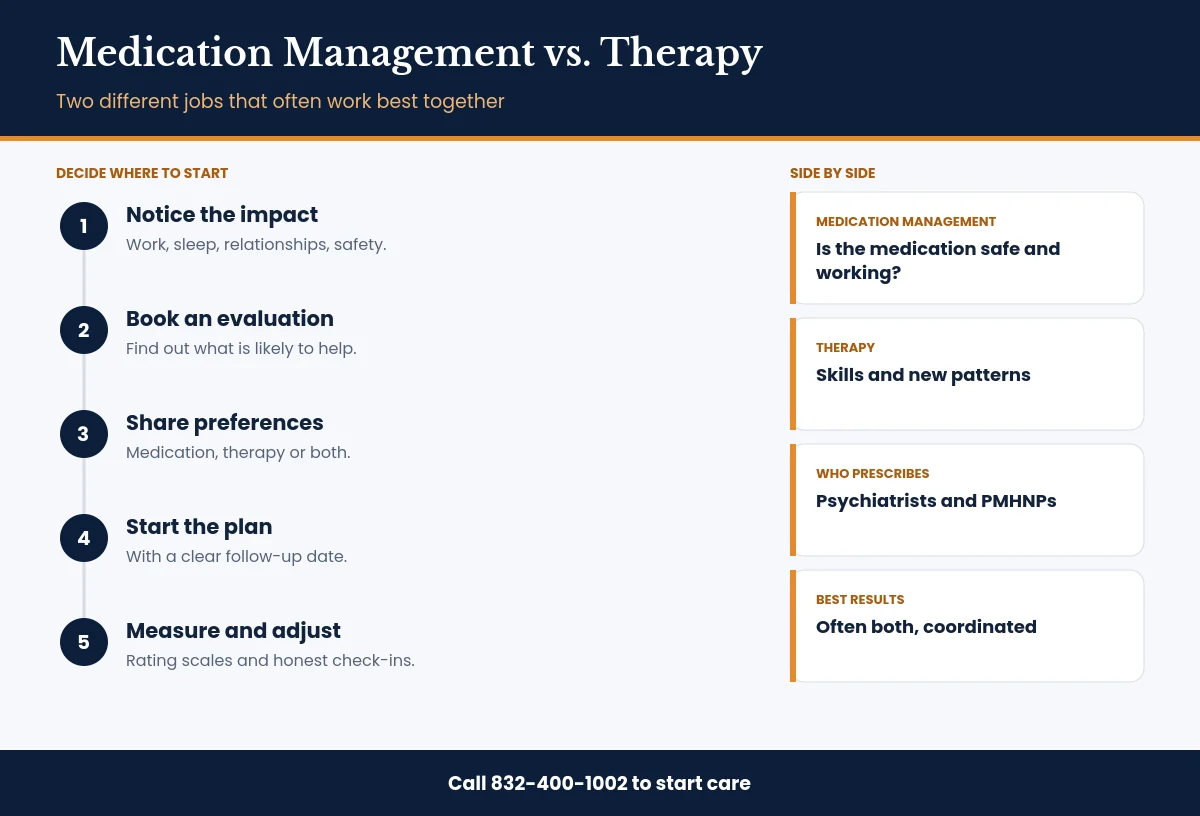
The right answer depends on the condition, its severity and your preferences. General patterns:
A psychiatric evaluation is the best way to sort this out for your situation.
Talk to a provider
In person in Sugar Land or Seattle, or by secure video in Texas, Washington and Colorado.
A follow-up visit is a focused conversation. Your provider usually asks how you have felt since the last appointment, whether you have noticed side effects, how often you missed doses and whether anything in your health or life has changed. Short rating scales may be repeated so progress can be compared over time.
The visit ends with a decision: continue the current plan, adjust the dose, switch medications or add another approach. You should leave knowing what changed, why, what to watch for and when your next visit is. If you are unsure about any of those, ask before the visit ends.
Treatment often needs fine-tuning. Talk to your prescriber or therapist if you notice any of these:
None of these mean treatment has failed. They mean the plan needs to change. Please do not stop a medication on your own; some medications cause withdrawal symptoms or relapse when stopped suddenly. Our guide to questions to ask about a new medication can help you prepare for that conversation.
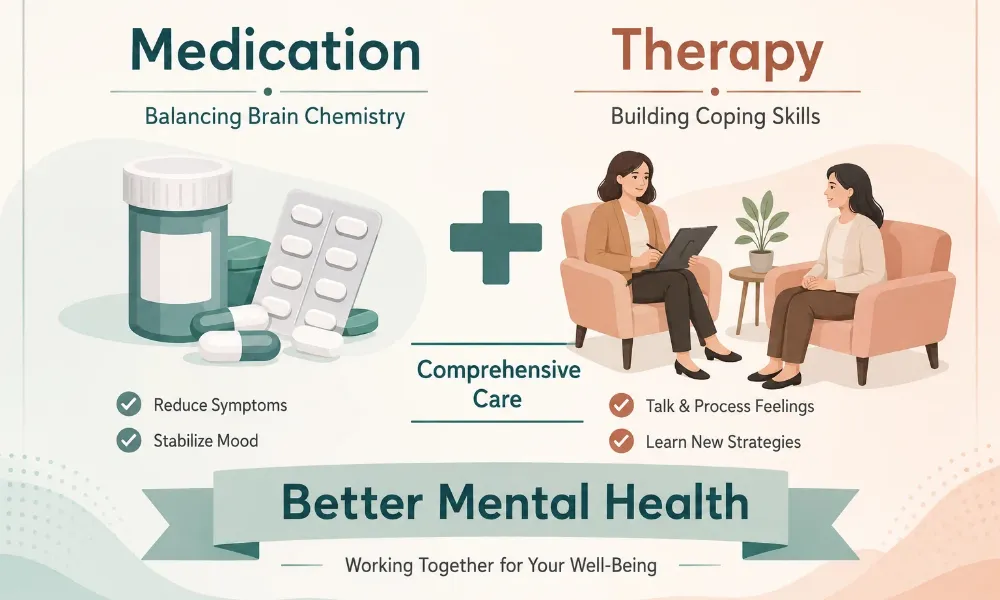
Medication can lower the volume of symptoms, such as constant worry or crushing low mood, so that therapy becomes possible. Therapy then builds skills that protect against relapse and help you handle stress without relying on medication alone.
Coordination matters. With your written permission, your prescriber and therapist can share updates, so medication changes and therapy goals line up. If you notice side effects that affect therapy, such as feeling flat or drowsy, tell both of them.
Tip: Keep one short list of your medications, doses and recent changes on your phone. Show it at both prescriber and therapy visits.
Both are usually covered under outpatient mental health benefits, with copays, coinsurance and deductibles that vary by plan. Medications are billed separately under your pharmacy benefit. Blissz Psychiatry accepts most major insurance plans and offers self-pay; payment is due 24 hours before each visit.
See our guides to insurance for medication management and checking your out-of-pocket costs.
No. Psychologists, counselors and social workers do not prescribe. Psychiatrists and psychiatric nurse practitioners do.
Medication management is one service psychiatric providers offer. Psychiatrists and psychiatric nurse practitioners both provide it.
They are shorter than the initial evaluation and focus on symptoms, side effects and dose. Our office can tell you what to expect.
Yes. For many people with mild to moderate symptoms, therapy alone is effective. Your provider will discuss what fits your situation.
Not necessarily. Some people reduce or stop medication after a period of stability, always with their prescriber’s guidance.
Visits include supportive therapy alongside medication management, and we coordinate with outside therapists when you have one.
Your next step
Medication, therapy or both, decided with you, not for you. Call our office or book online.
About this article
Written by the Blissz Psychiatry Clinical Team and medically reviewed by Macbarbara Amaechi, PMHNP-BC, a board-certified psychiatric mental health nurse practitioner who provides psychiatric evaluations, medication management and supportive therapy in Sugar Land, TX, Seattle, WA, and by telehealth in Texas, Washington and Colorado. We check our articles against the sources listed below and update them when guidance changes.
Medical disclaimer: This article is for general education and is not a substitute for an individual evaluation, diagnosis or treatment. Do not start, stop or change a medication without talking to your prescriber. If you are in crisis, call or text 988, or call 911 in an emergency. Blissz Psychiatry is an outpatient practice and does not provide emergency services.
Keep Reading
 Mental Health CareWhat Conditions Can a PMHNP Diagnose and Treat?What a psychiatric nurse practitioner (PMHNP) can diagnose, treat and prescribe, and when a psychiatrist fits better. Call 832-400-1002.Nov 21, 2026 · 8 min read
 Mental Health CareWhat Should I Ask Before Starting a New Psychiatric Medication?The questions to ask before starting a new psychiatric medication: purpose, timing, side effects, interactions, safety and stopping. Call 832-400-1002.Nov 20, 2026 · 7 min read
 Mental Health CareWhat Happens During a First Psychiatric Evaluation?What really happens at a first psychiatric evaluation: the questions, the timeline, what to bring and what you leave with. Call 832-400-1002.Nov 22, 2026 · 8 min read
Related care at Blissz Psychiatry
Now accepting new patients
Tell us how to reach you, then pick your location to choose a time that works.
Prefer to talk? Call 832-400-1002
Step 1 of 2 · Your details
Share a few details and we will help you book with a board-certified provider. It takes about a minute, and no medical details are needed.
Step 2 of 2 · Select your schedule
Please select your schedule: choose a time on the secure booking calendar for the state you will be in during your visit.
Questions or trouble booking? Call 832-400-1002. In crisis? Call or text 988.
Book online
Choose the state you will be in at the time of your visit.