


Accepting new patients · In-person & telehealth

Home/Blog/What a PMHNP Treats

What Conditions Can a PMHNP Diagnose and Treat?

What psychiatric mental health nurse practitioners are trained to do, which conditions they treat most often, how state rules shape their practice, and when another level of care fits better.

By the Blissz Psychiatry Clinical TeamMedically reviewed by Macbarbara Amaechi, PMHNP-BCPublished November 21, 20268 min read

Nurse practitioner in scrubs reviewing notes at a computer
Psychiatric nurse practitioners evaluate, diagnose, prescribe and provide therapy.

Quick answer

A board-certified psychiatric mental health nurse practitioner (PMHNP) can evaluate, diagnose and treat most outpatient mental health conditions, including depression, anxiety, ADHD, bipolar disorder, OCD, PTSD, insomnia and substance use disorders, and can prescribe psychiatric medication and provide therapy. PMHNPs hold a graduate nursing degree and pass a national board certification exam. State law shapes how they practice: in Texas they prescribe under an agreement with a physician, while Washington and Colorado grant broader independent authority. Very complex or emergency cases may need a psychiatrist-led or hospital setting.

What is a PMHNP?

A psychiatric mental health nurse practitioner is an advanced practice registered nurse who specializes in mental health. The path usually includes a nursing license, clinical experience, then a master’s or doctoral degree with focused training in psychiatric assessment, diagnosis, psychopharmacology and psychotherapy.

After graduate school, PMHNPs can sit for a national board certification exam. The credential PMHNP-BC means the provider passed that exam and maintains certification through continuing education and clinical practice. To prescribe controlled medications, such as ADHD stimulants, they also need federal and state registrations.

At Blissz Psychiatry, care is led by Macbarbara Amaechi, PMHNP-BC. Read our comparison of psychiatrists and PMHNPs for a closer look at training differences.

Which conditions can a PMHNP diagnose and treat?

PMHNPs diagnose using the same criteria psychiatrists use. In outpatient practice, the most common conditions include:

The PMHNP certification covers patients across the lifespan, but individual practices set their own age ranges. At Blissz Psychiatry, call the office to confirm age eligibility before booking.

Many patients have more than one condition at once, such as ADHD with anxiety or depression with insomnia. Part of a PMHNP’s job is sorting out which symptoms belong to which condition, and treating them in the right order.

Talk to a provider

See a board-certified PMHNP

Evaluation, diagnosis, medication management and supportive therapy, in person or by secure video.

What treatments can a PMHNP provide?

Scope at a glance
ServiceWhat it involves
Psychiatric evaluationFull assessment of symptoms, history, medications and safety
DiagnosisUsing standard diagnostic criteria, with rating scales and testing as needed
Medication managementStarting, adjusting and monitoring psychiatric medications, including controlled medications with the required registrations
TherapySupportive and skills-based therapy within the visit
Ordering testsLab work or objective testing, such as computer-based ADHD testing
Coordination and referralWorking with therapists, primary care and specialists, and referring to higher levels of care

Some PMHNPs also oversee interventional treatments such as TMS therapy, depending on the practice and state rules.

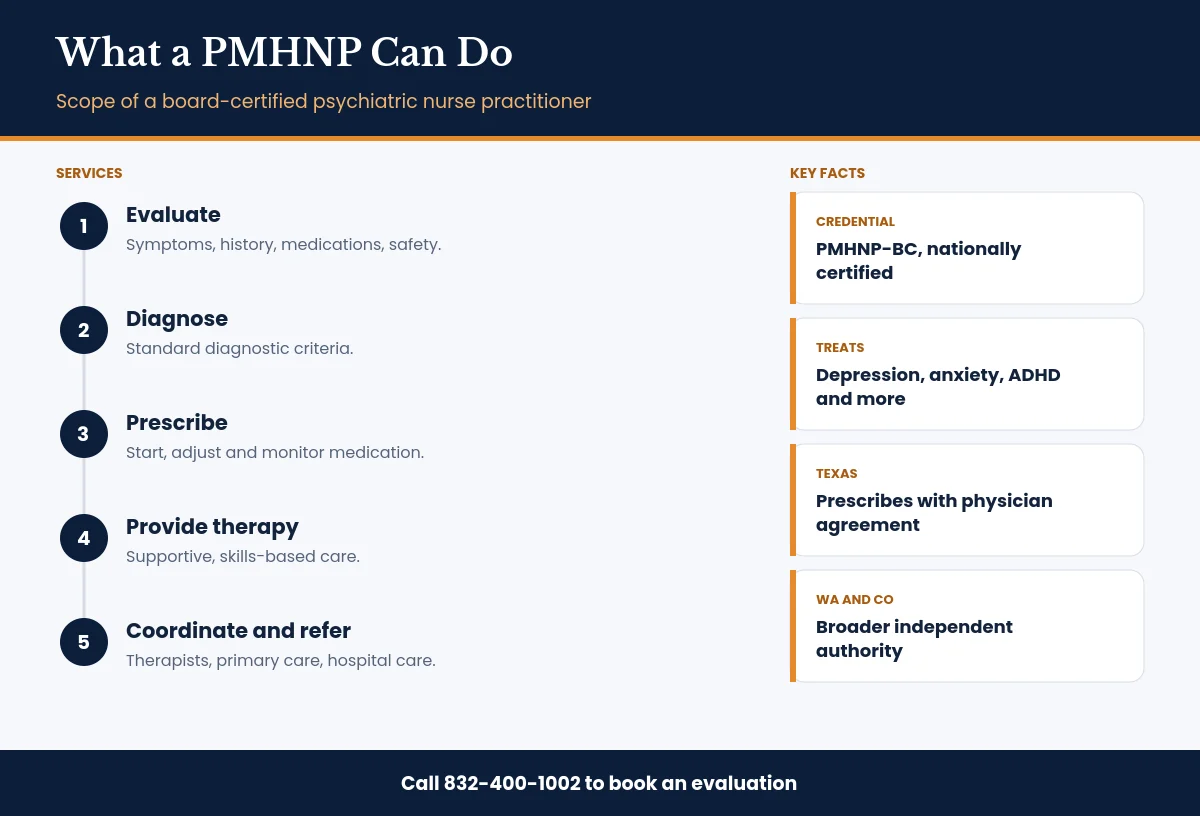
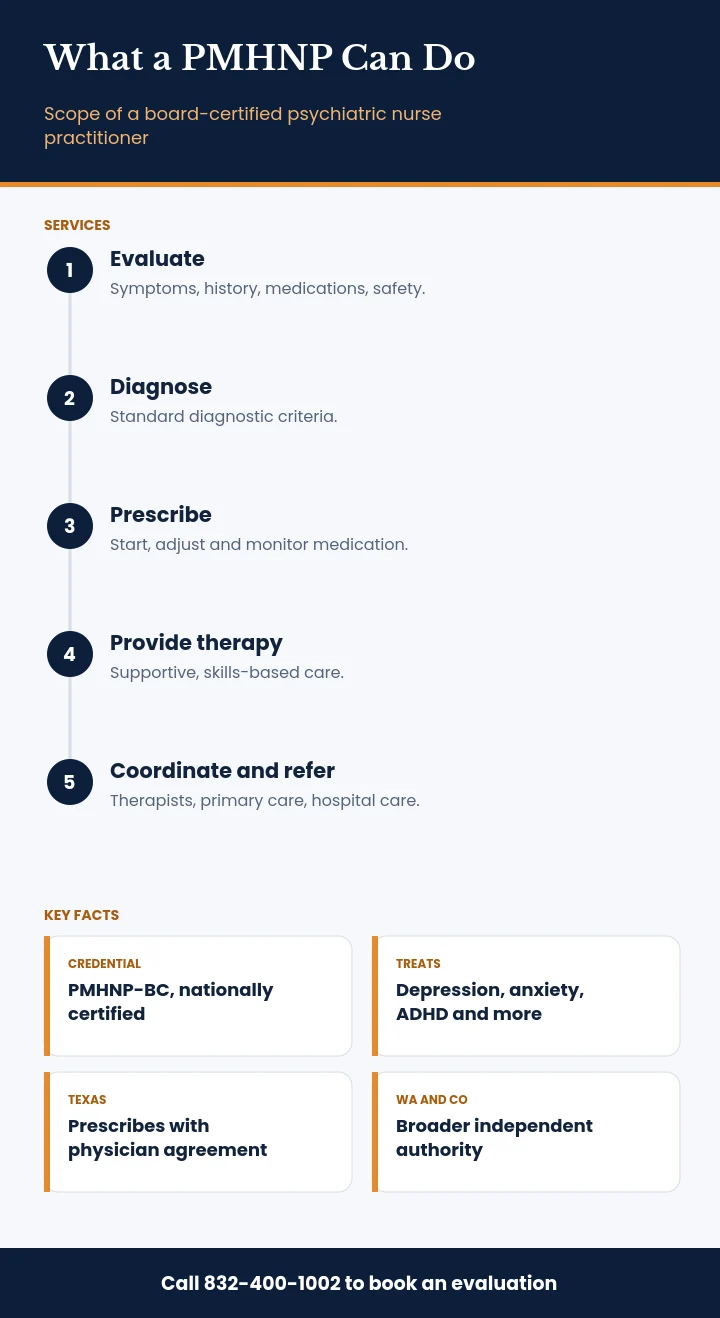
Infographic of the services a psychiatric mental health nurse practitioner provides and key facts about PMHNP credentials and state practice rules
What a board-certified psychiatric mental health nurse practitioner can do, from evaluation to coordination, with key facts on credentials and state rules.

How do state laws shape what a PMHNP can do?

Nurse practitioner practice rules are set by each state. In broad terms:

  • Texas requires nurse practitioners to prescribe under a prescriptive authority agreement with a physician. The NP still evaluates, diagnoses and manages treatment day to day.
  • Washington and Colorado give nurse practitioners broader independent practice and prescribing authority.

For patients, the practical difference is small. In every state, a licensed, board-certified PMHNP provides evaluations, diagnosis, medication management and follow-up. The rules mainly affect how the practice is organized behind the scenes. Licensing also explains why telehealth depends on where you are; see our guide to telehealth across state lines.

How is a PMHNP different from a psychiatrist in practice?

The biggest difference is training path. A psychiatrist completes medical school and a four-year psychiatry residency. A PMHNP completes nursing education, clinical nursing experience and graduate psychiatric training, then national board certification.

Day to day, outpatient visits look very similar. Both take a full history, diagnose, prescribe, monitor side effects and adjust treatment. Many patients notice that nurse practitioners spend time on education and practical coping strategies, reflecting nursing’s focus on the whole person, but style varies by individual provider more than by credential.

What matters most for you is fit: a provider who is licensed where you are, treats your condition, explains decisions clearly and is available for follow-up. Credentials are a starting point; the relationship and the quality of the evaluation drive results.

Man resting his head on his hand, looking thoughtful
Most outpatient mental health concerns can be evaluated and treated by a board-certified PMHNP.

Talk to a provider

Not sure we treat your concern?

Call the office and ask. If we are not the right fit, we will help you find the right level of care.

When might you need a psychiatrist or a higher level of care?

Outpatient PMHNP care fits most people. A psychiatrist-led team, hospital program or specialized service may be a better fit when someone needs:

  • Inpatient or emergency psychiatric care
  • Treatment for severe psychosis that is not stable
  • Electroconvulsive therapy or other hospital-based procedures
  • Very complex medical and psychiatric conditions that require close coordination with hospital specialists
  • Medically supervised detox

A good outpatient provider recognizes these situations and helps you get to the right place. If that applies to you, we will say so and help with the referral.

When to seek care sooner: If you are thinking about suicide or are in immediate danger, call or text 988, call 911 or go to the nearest emergency room. Outpatient practices are not emergency services.

Most people need only one or two visits to know whether a provider is the right fit. If something feels off, such as rushed visits or unanswered questions, say so. A good provider welcomes that feedback, and switching is always an option.

How do you start care with a PMHNP?

  1. Check fit. Confirm the practice treats your concern and sees patients in your state.
  2. Verify coverage. Ask your plan whether outpatient mental health visits with the practice are covered.
  3. Book an evaluation. Call 832-400-1002 or book online, in person or by video.
  4. Prepare. Bring a medication list, past records and your main concerns.
  5. Agree on a plan. Medication, therapy, testing, TMS or a referral, decided together.
  6. Follow up. Regular visits track progress and adjust treatment.

What does care with a PMHNP cost?

Insurance plans generally cover PMHNP visits under the same outpatient mental health benefits as psychiatrist visits, with your usual copay, coinsurance and deductible. Blissz Psychiatry accepts most major insurance plans and offers self-pay; payment is due 24 hours before the appointment. See our guide to checking your costs before you book.

Key takeaways

  • A PMHNP is an advanced practice nurse with graduate training in psychiatric assessment, diagnosis, medication and therapy.
  • PMHNPs diagnose and treat most outpatient conditions, including depression, anxiety, ADHD, bipolar disorder, OCD, PTSD and insomnia.
  • They prescribe psychiatric medications, including controlled medications with the required registrations.
  • State law shapes practice structure: Texas requires a physician agreement; Washington and Colorado grant broader authority.
  • Emergency, inpatient and very complex cases may need a psychiatrist-led or hospital setting.

Frequently asked questions

No. A psychiatrist is a medical doctor with a psychiatry residency. A PMHNP is an advanced practice nurse with graduate psychiatric training. Both evaluate, diagnose and prescribe for most outpatient conditions.

Yes, with the required federal and state registrations for controlled substances, after an evaluation shows medication is appropriate.

Yes. PMHNPs diagnose bipolar disorder using standard criteria and manage mood stabilizers and other treatments.

Most plans cover PMHNP visits under outpatient mental health benefits, the same way they cover other psychiatric visits.

BC means board certified. The provider passed a national certification exam in psychiatric mental health nursing and maintains the credential.

Yes. PMHNPs are trained in psychotherapy and often combine supportive therapy with medication management.

Your next step

Expert psychiatric care, start to finish

Evaluation, diagnosis, medication management and therapy with a board-certified PMHNP. Call our office or book online.

About this article

Written by the Blissz Psychiatry Clinical Team and medically reviewed by Macbarbara Amaechi, PMHNP-BC, a board-certified psychiatric mental health nurse practitioner who provides psychiatric evaluations, medication management and supportive therapy in Sugar Land, TX, Seattle, WA, and by telehealth in Texas, Washington and Colorado. We check our articles against the sources listed below and update them when guidance changes.

Sources and further reading

Medical disclaimer: This article is for general education and is not a substitute for an individual evaluation, diagnosis or treatment. Do not start, stop or change a medication without talking to your prescriber. If you are in crisis, call or text 988, or call 911 in an emergency. Blissz Psychiatry is an outpatient practice and does not provide emergency services.

Now accepting new patients

Start care with a board-certified provider

Tell us how to reach you, then pick your location to choose a time that works.

Prefer to talk? Call 832-400-1002

Step 1 of 2 · Your details

Need a Consultation or Appointment?

Share a few details and we will help you book with a board-certified provider. It takes about a minute, and no medical details are needed.

Step 2 of 2 · Select your schedule

Many thanks for your interest!

Please select your schedule: choose a time on the secure booking calendar for the state you will be in during your visit.

Questions or trouble booking? Call 832-400-1002. In crisis? Call or text 988.

Call us832-400-1002