

Accepting new patients · In-person & telehealth

Home/Blog/Verify Your Costs

How Do I Verify My Out-of-Pocket Costs Before an Appointment?

A plain-English guide to deductibles, copays and coinsurance, a call script for your insurance plan, and your rights to a Good Faith Estimate if you pay without insurance.

By the Blissz Psychiatry Clinical TeamMedically reviewed by Macbarbara Amaechi, PMHNP-BCPublished November 20, 20268 min read

Man at a laptop holding his head while sorting through bills
A ten-minute call to your plan can answer most cost questions before your first visit.

Quick answer

To verify your out-of-pocket costs, call the member services number on your insurance card, ask whether the practice is in network, then ask what you will owe for the specific service, such as an initial psychiatric evaluation, including your copay or coinsurance, how much of your deductible is left and whether a referral or prior authorization is required. Write down the date and a reference number. If you are uninsured or paying yourself, you have a federal right to a written Good Faith Estimate before your visit.

What insurance terms do you need to understand?

Key terms
TermWhat it means
Allowed amountThe maximum your plan pays for a covered service
DeductibleWhat you pay each year before your plan starts sharing costs
CopayA fixed amount per visit, such as a flat fee for an office visit
CoinsuranceA percentage of the allowed amount you pay after the deductible
Out-of-pocket maximumThe most you pay in a plan year for covered in-network care
In networkThe provider has a contract with your plan, which usually lowers your cost
Prior authorizationPlan approval required before certain services, such as TMS

Mental health visits may fall under a separate behavioral health benefit with its own copays, so always ask specifically about outpatient mental health.

How do you verify your costs, step by step?

  1. Gather your details. Insurance card, member ID, date of birth and the practice name, address and phone number.
  2. Call member services. Use the number on the back of your card, and choose the behavioral or mental health option if offered.
  3. Confirm the network. Ask whether Blissz Psychiatry and your provider are in network for your plan, in person and by telehealth.
  4. Ask about the specific service. Name the visit type and, if you can, the billing code.
  5. Ask what you will owe. Copay or coinsurance, remaining deductible and out-of-pocket maximum.
  6. Ask about requirements. Referral, prior authorization or visit limits.
  7. Document the call. Write down the date, the representative’s name and a reference number.
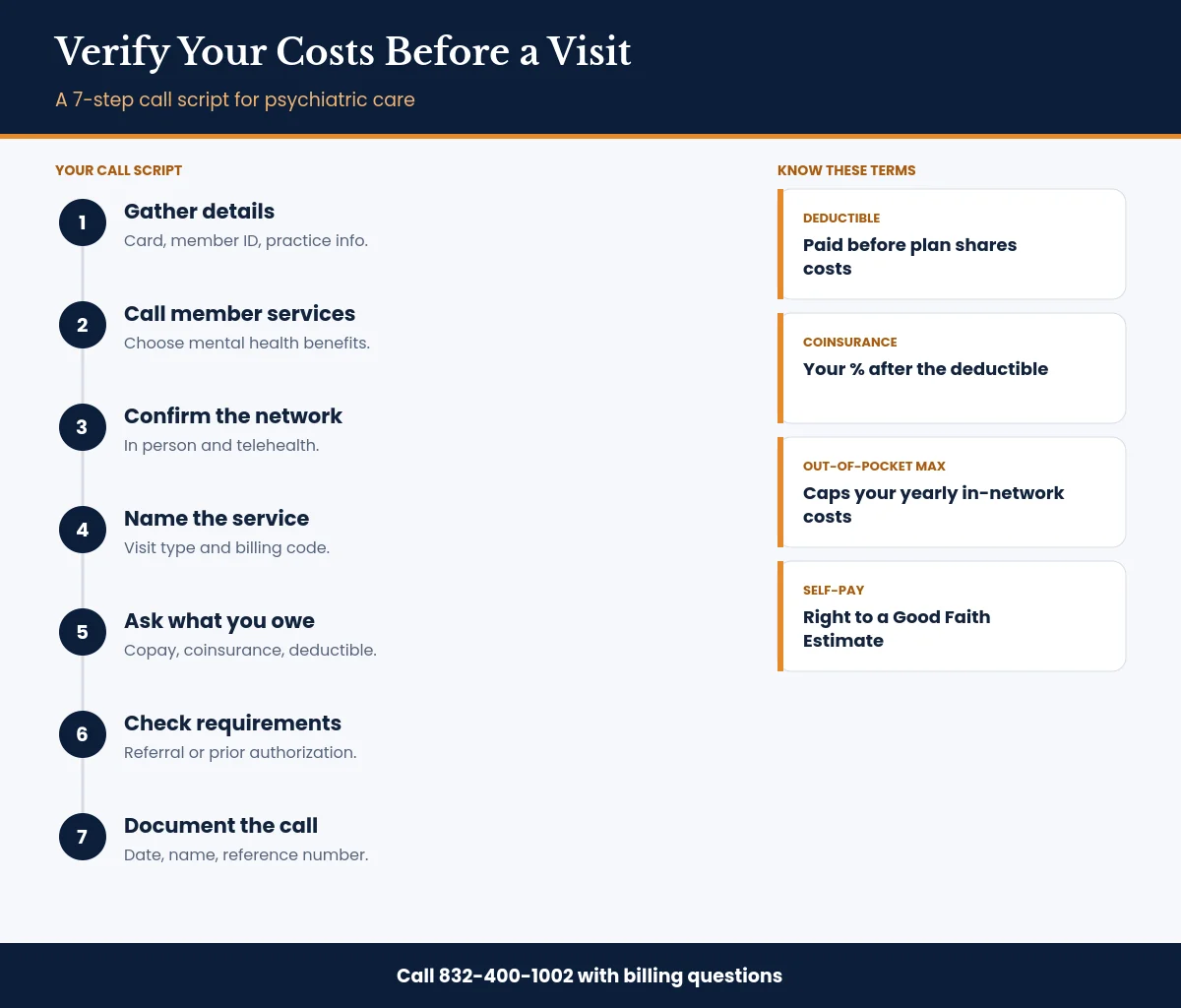
Infographic with a seven-step insurance call script for verifying psychiatric visit costs and definitions of key insurance terms
A seven-step call script to verify out-of-pocket costs for psychiatric care, plus the key insurance terms to know.
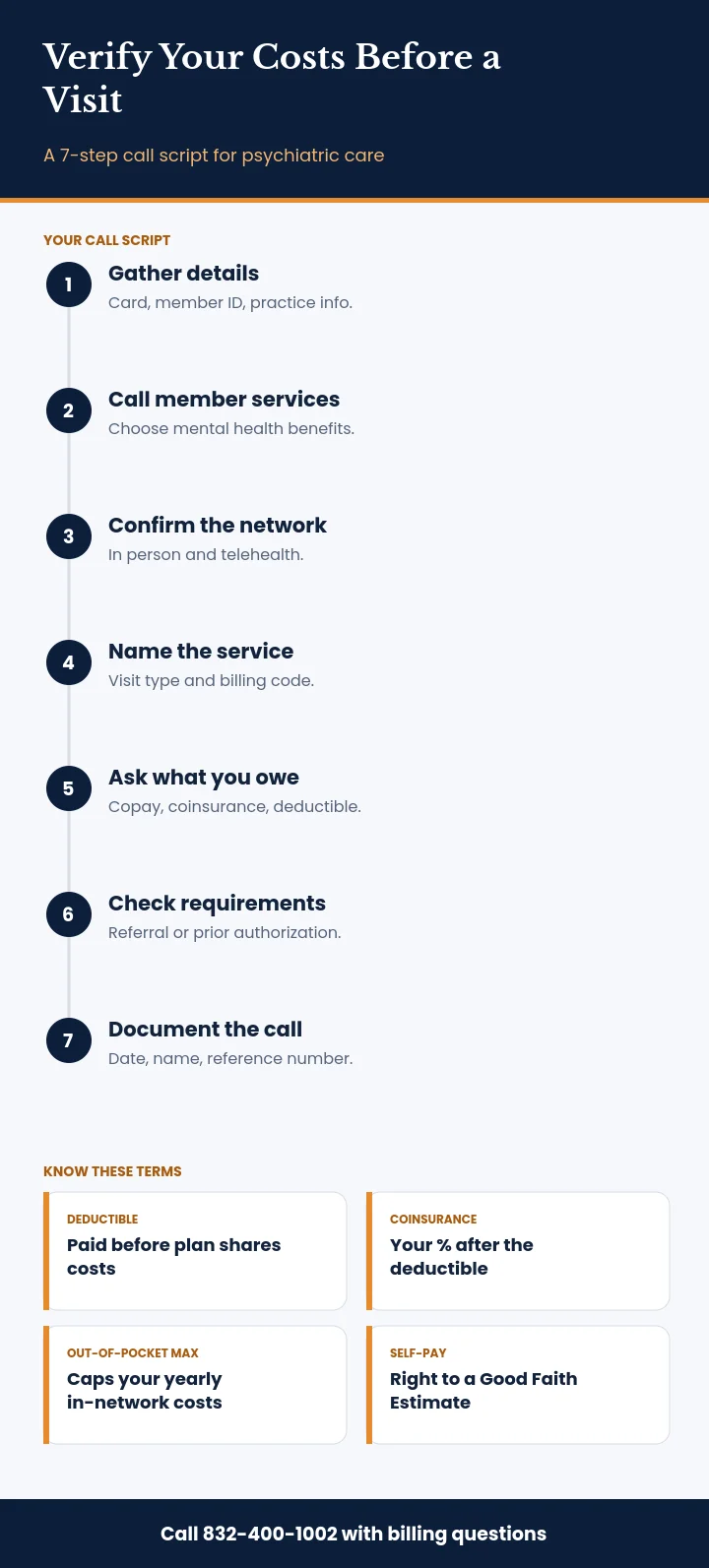
Infographic with a seven-step insurance call script for verifying psychiatric visit costs and definitions of key insurance terms
A seven-step call script to verify out-of-pocket costs for psychiatric care, plus the key insurance terms to know.

Talk to a provider

Want help understanding your benefits?

Call our office before your visit. We will tell you what to ask your plan and how payment works.

Which billing codes should you ask about?

Plans answer more accurately when you give a code. These are the codes most often used in outpatient psychiatry:

  • 90791 or 90792: initial psychiatric diagnostic evaluation
  • 99213 or 99214: follow-up medication management visits, depending on complexity
  • 90833: add-on code when psychotherapy is provided in the same visit
  • 90867, 90868, 90869: TMS therapy mapping, treatment sessions and motor threshold re-checks

The codes actually billed depend on the care you receive, so treat this as a guide for your call. For TMS, see our article on insurance coverage for TMS and medication management.

How do you estimate what you will actually pay?

Once you have your plan’s answers, the math is straightforward. Here is an illustration with made-up numbers, not actual rates:

Suppose the allowed amount for a visit is $200, you have $150 left on your deductible, and your coinsurance is 20%. You pay the first $150 toward your deductible, then 20% of the remaining $50, which is $10. Your estimated cost is $160. At your next visit, with the deductible met, you would pay 20% of $200, which is $40.

If your plan uses a copay instead, you pay the flat copay, sometimes only after the deductible. Ask which applies.

Tip: Check how much of your out-of-pocket maximum you have already met. For treatments with many visits, such as TMS, the maximum often caps your total cost.

Laptop showing a mental health page next to a notebook and a cup of tea
Keep your call notes, reference numbers and estimates in one place.

What are your rights if you pay without insurance?

Under the federal No Surprises Act, if you are uninsured or choose not to use insurance, providers generally must give you a Good Faith Estimate of expected charges when you schedule care at least three business days ahead, or when you ask for one.

  • Ask for the estimate in writing and keep it.
  • Compare it with your final bill.
  • If the bill is at least $400 more than the estimate, you can start a patient-provider dispute resolution process.
  • You must start the dispute within 120 days of receiving the initial bill.

Blissz Psychiatry offers self-pay; call 832-400-1002 for current rates and ask for a Good Faith Estimate.

Talk to a provider

Ready to book with confidence?

Once you know your costs, scheduling takes a few minutes. In person in Sugar Land or Seattle, or by secure video.

How do you check medication costs, not just visit costs?

Visits and prescriptions are covered under different parts of your plan. Psychiatric visits fall under your medical or behavioral health benefit; medications fall under your pharmacy benefit, which has its own formulary, tiers and sometimes a separate deductible.

To check a medication cost, ask your plan or pharmacy:

  • Is this medication on my formulary, and which tier is it?
  • Is there a generic version, and what does it cost?
  • Does it need prior authorization or step therapy?
  • Is a 90-day supply or mail order cheaper?

If a medication costs more than you can manage, tell your prescriber before you stop taking it. There is often an equally appropriate, lower-cost option. Our guide to questions to ask about a new medication covers this conversation.

What payment policies should you ask the practice about?

Your plan explains what it covers; the practice explains how payment works. Ask about:

  • When payment is due. At Blissz Psychiatry, payment for insured and self-pay visits is due 24 hours before the appointment.
  • Accepted payment methods. We accept major credit and debit cards.
  • Cancellation and no-show policies, which can carry fees.
  • Separate charges, such as QbCheck ADHD testing, which costs $150.

See our patient policies, insurance page and cost of care guide.

What if the bill does not match what you were told?

Start with the explanation of benefits (EOB) from your plan, which shows what was billed, allowed and paid. Then:

  1. Compare the EOB with the bill and your call notes.
  2. Call the practice to confirm the codes billed and whether the claim was processed correctly.
  3. Call your plan with your reference number from the earlier call.
  4. Ask for a reprocessing or file an appeal if the claim was denied or processed incorrectly.

Most billing problems are simple errors, such as an outdated member ID or a missing referral, and are fixed with one or two calls.

Key takeaways

  • Call the member services number on your card and ask specifically about outpatient mental health benefits.
  • Confirm the practice is in network, then ask about copay, coinsurance, remaining deductible and out-of-pocket maximum.
  • Give billing codes, such as 90791 for an initial evaluation, to get more accurate answers.
  • Write down the date, representative’s name and reference number for every call.
  • If you pay without insurance, you have a right to a written Good Faith Estimate and can dispute bills $400 or more above it.

Frequently asked questions

The practice can explain its fees and policies, but your plan determines your share. Combine the practice’s information with your plan’s answers.

A copay is a fixed amount per visit. Coinsurance is a percentage of the allowed amount, usually after your deductible.

Often, but not always. Ask your plan whether telehealth mental health visits have the same copay or coinsurance.

A written estimate of expected charges that uninsured and self-pay patients have a federal right to receive before scheduled care.

Payment for insured and self-pay visits is due 24 hours before the appointment. We accept major credit and debit cards.

Ask your primary care provider for a referral before your first visit, and confirm the plan has received it.

Your next step

No surprises, just care

Know your costs, then book your visit. Our office is happy to walk you through payment and benefits.

About this article

Written by the Blissz Psychiatry Clinical Team and medically reviewed by Macbarbara Amaechi, PMHNP-BC, a board-certified psychiatric mental health nurse practitioner who provides psychiatric evaluations, medication management and supportive therapy in Sugar Land, TX, Seattle, WA, and by telehealth in Texas, Washington and Colorado. We check our articles against the sources listed below and update them when guidance changes.

Sources and further reading

Medical disclaimer: This article is for general education and is not a substitute for an individual evaluation, diagnosis or treatment. Do not start, stop or change a medication without talking to your prescriber. If you are in crisis, call or text 988, or call 911 in an emergency. Blissz Psychiatry is an outpatient practice and does not provide emergency services.

Now accepting new patients

Start care with a board-certified provider

Tell us how to reach you, then pick your location to choose a time that works.

Prefer to talk? Call 832-400-1002

Step 1 of 2 · Your details

Need a Consultation or Appointment?

Share a few details and we will help you book with a board-certified provider. It takes about a minute, and no medical details are needed.

Step 2 of 2 · Select your schedule

Many thanks for your interest!

Please select your schedule: choose a time on the secure booking calendar for the state you will be in during your visit.

Questions or trouble booking? Call 832-400-1002. In crisis? Call or text 988.

Call us832-400-1002