

Accepting new patients · In-person & telehealth
A plain-English guide to deductibles, copays and coinsurance, a call script for your insurance plan, and your rights to a Good Faith Estimate if you pay without insurance.
By the Blissz Psychiatry Clinical TeamMedically reviewed by Macbarbara Amaechi, PMHNP-BCPublished November 20, 20268 min read
Quick answer
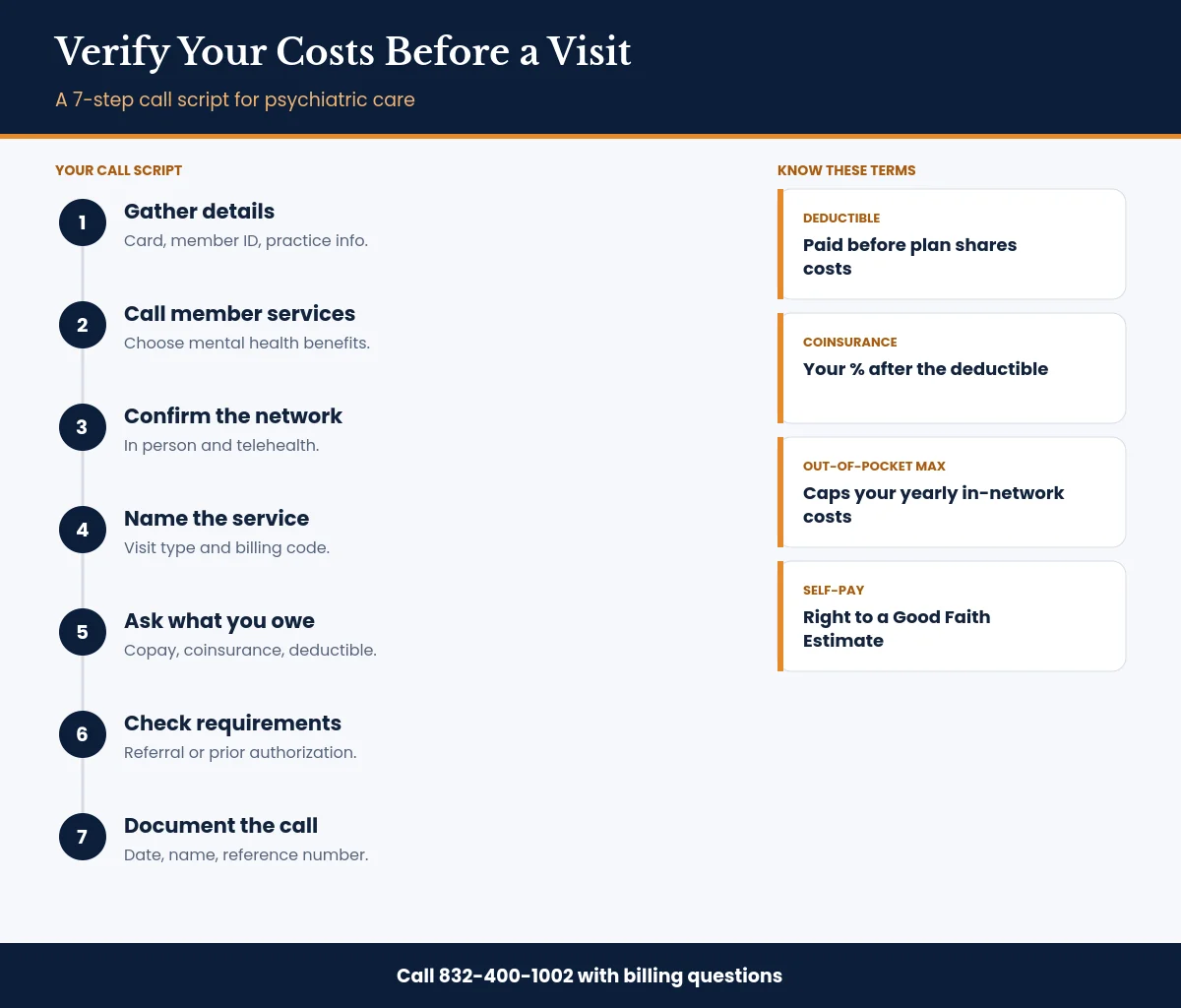
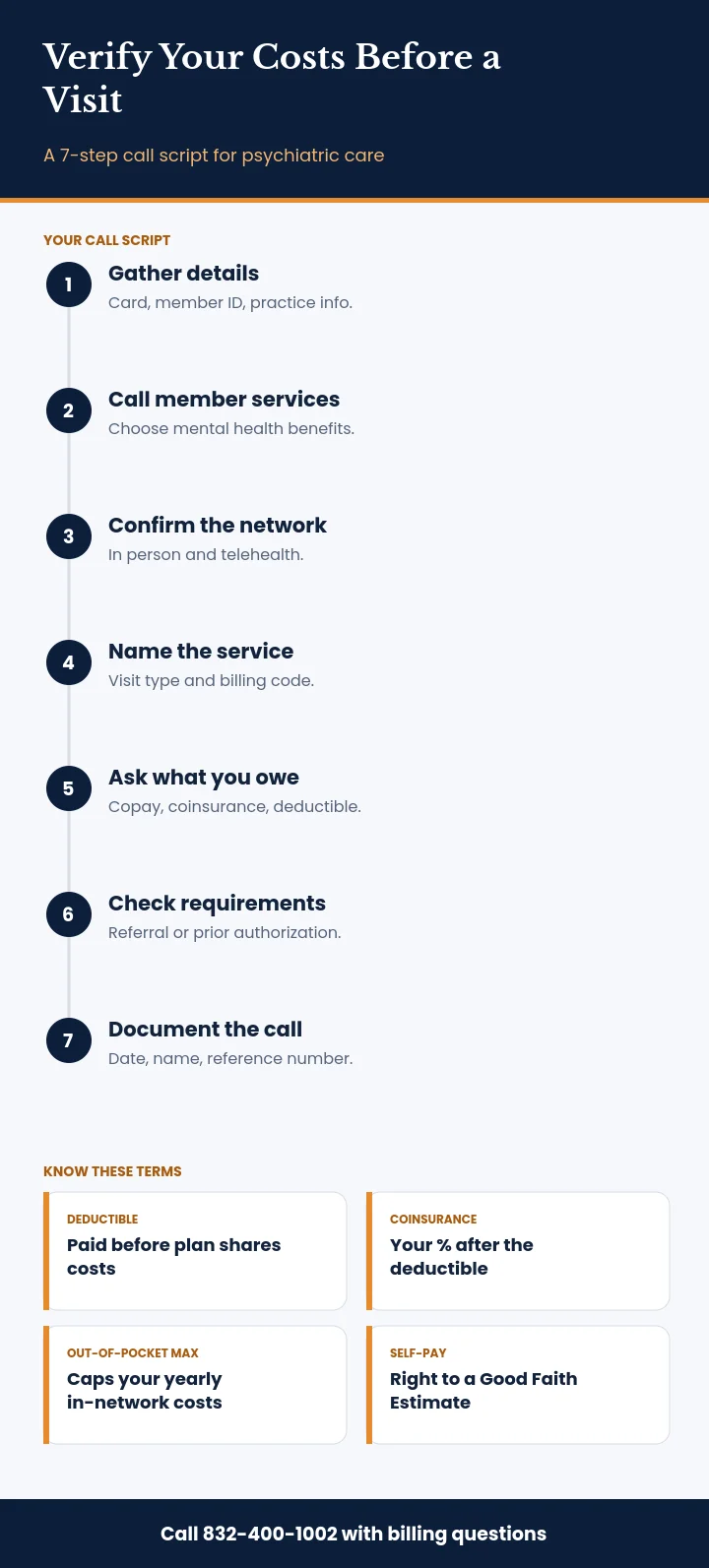
To verify your out-of-pocket costs, call the member services number on your insurance card, ask whether the practice is in network, then ask what you will owe for the specific service, such as an initial psychiatric evaluation, including your copay or coinsurance, how much of your deductible is left and whether a referral or prior authorization is required. Write down the date and a reference number. If you are uninsured or paying yourself, you have a federal right to a written Good Faith Estimate before your visit.
In this article
| Term | What it means |
|---|---|
| Allowed amount | The maximum your plan pays for a covered service |
| Deductible | What you pay each year before your plan starts sharing costs |
| Copay | A fixed amount per visit, such as a flat fee for an office visit |
| Coinsurance | A percentage of the allowed amount you pay after the deductible |
| Out-of-pocket maximum | The most you pay in a plan year for covered in-network care |
| In network | The provider has a contract with your plan, which usually lowers your cost |
| Prior authorization | Plan approval required before certain services, such as TMS |
Mental health visits may fall under a separate behavioral health benefit with its own copays, so always ask specifically about outpatient mental health.
Talk to a provider
Call our office before your visit. We will tell you what to ask your plan and how payment works.
Plans answer more accurately when you give a code. These are the codes most often used in outpatient psychiatry:
The codes actually billed depend on the care you receive, so treat this as a guide for your call. For TMS, see our article on insurance coverage for TMS and medication management.
Once you have your plan’s answers, the math is straightforward. Here is an illustration with made-up numbers, not actual rates:
Suppose the allowed amount for a visit is $200, you have $150 left on your deductible, and your coinsurance is 20%. You pay the first $150 toward your deductible, then 20% of the remaining $50, which is $10. Your estimated cost is $160. At your next visit, with the deductible met, you would pay 20% of $200, which is $40.
If your plan uses a copay instead, you pay the flat copay, sometimes only after the deductible. Ask which applies.
Tip: Check how much of your out-of-pocket maximum you have already met. For treatments with many visits, such as TMS, the maximum often caps your total cost.
Under the federal No Surprises Act, if you are uninsured or choose not to use insurance, providers generally must give you a Good Faith Estimate of expected charges when you schedule care at least three business days ahead, or when you ask for one.
Blissz Psychiatry offers self-pay; call 832-400-1002 for current rates and ask for a Good Faith Estimate.
Talk to a provider
Once you know your costs, scheduling takes a few minutes. In person in Sugar Land or Seattle, or by secure video.
Visits and prescriptions are covered under different parts of your plan. Psychiatric visits fall under your medical or behavioral health benefit; medications fall under your pharmacy benefit, which has its own formulary, tiers and sometimes a separate deductible.
To check a medication cost, ask your plan or pharmacy:
If a medication costs more than you can manage, tell your prescriber before you stop taking it. There is often an equally appropriate, lower-cost option. Our guide to questions to ask about a new medication covers this conversation.
Your plan explains what it covers; the practice explains how payment works. Ask about:
See our patient policies, insurance page and cost of care guide.
Start with the explanation of benefits (EOB) from your plan, which shows what was billed, allowed and paid. Then:
Most billing problems are simple errors, such as an outdated member ID or a missing referral, and are fixed with one or two calls.
The practice can explain its fees and policies, but your plan determines your share. Combine the practice’s information with your plan’s answers.
A copay is a fixed amount per visit. Coinsurance is a percentage of the allowed amount, usually after your deductible.
Often, but not always. Ask your plan whether telehealth mental health visits have the same copay or coinsurance.
A written estimate of expected charges that uninsured and self-pay patients have a federal right to receive before scheduled care.
Payment for insured and self-pay visits is due 24 hours before the appointment. We accept major credit and debit cards.
Ask your primary care provider for a referral before your first visit, and confirm the plan has received it.
Your next step
Know your costs, then book your visit. Our office is happy to walk you through payment and benefits.
About this article
Written by the Blissz Psychiatry Clinical Team and medically reviewed by Macbarbara Amaechi, PMHNP-BC, a board-certified psychiatric mental health nurse practitioner who provides psychiatric evaluations, medication management and supportive therapy in Sugar Land, TX, Seattle, WA, and by telehealth in Texas, Washington and Colorado. We check our articles against the sources listed below and update them when guidance changes.
Medical disclaimer: This article is for general education and is not a substitute for an individual evaluation, diagnosis or treatment. Do not start, stop or change a medication without talking to your prescriber. If you are in crisis, call or text 988, or call 911 in an emergency. Blissz Psychiatry is an outpatient practice and does not provide emergency services.
Keep Reading
Patient ResourcesDoes Insurance Cover TMS Therapy and Medication Management?How insurance covers TMS therapy and psychiatric medication management: billing codes, prior authorization, costs and appeals. Call 832-400-1002.Nov 21, 2026 · 8 min read
Mental Health CareWhat Happens During a First Psychiatric Evaluation?What really happens at a first psychiatric evaluation: the questions, the timeline, what to bring and what you leave with. Call 832-400-1002.Nov 22, 2026 · 8 min read
ADHDHow Does QbCheck ADHD Testing Work From Home?QbCheck is a 20-minute, FDA-cleared ADHD test you take at home with a webcam. Learn how it works, how to prepare and what it costs. Call 832-400-1002.Nov 22, 2026 · 9 min readRelated care at Blissz Psychiatry
Now accepting new patients
Tell us how to reach you, then pick your location to choose a time that works.
Prefer to talk? Call 832-400-1002
Step 1 of 2 · Your details
Share a few details and we will help you book with a board-certified provider. It takes about a minute, and no medical details are needed.
Step 2 of 2 · Select your schedule
Please select your schedule: choose a time on the secure booking calendar for the state you will be in during your visit.
Questions or trouble booking? Call 832-400-1002. In crisis? Call or text 988.
Book online
Choose the state you will be in at the time of your visit.