Accepting new patients · In-person & telehealth
TMS (transcranial magnetic stimulation) is an FDA-cleared, non-drug treatment for major depression that has not improved enough with medication. Treatment is given at our Sugar Land office at 12930 Dairy Ashford Rd, Suite 701: you stay awake, need no anesthesia and can drive yourself home. A typical course is about five sessions a week for roughly six weeks, followed by a short taper. Many insurance plans, including Medicare, cover TMS when criteria are met. Care is overseen by Macbarbara Amaechi, APRN, PMHNP-BC.

At a Glance
Who we help, how the first visit works and what treatment can include.
Transcranial magnetic stimulation (TMS) uses focused magnetic pulses, delivered through a coil placed against the scalp, to stimulate areas of the brain involved in mood regulation, most often the left dorsolateral prefrontal cortex. Repeated over a course of sessions, this stimulation is thought to strengthen communication in mood networks, a process called neuroplasticity.
The FDA first cleared TMS for major depressive disorder in 2008, and certain devices have since been cleared for obsessive-compulsive disorder (OCD) and other uses. Unlike medication, TMS does not circulate through the body, so it does not cause weight gain, sexual side effects or drowsiness. Unlike electroconvulsive therapy (ECT), it requires no anesthesia and does not cause memory loss.
TMS may be a good fit if you:
TMS is generally not appropriate for people with metal implants in or near the head (such as aneurysm clips, cochlear implants or deep brain stimulators), and a history of seizures needs careful review. Dental fillings and braces are typically fine. Eligibility can only be confirmed after a psychiatric evaluation. Read more in our guide on who qualifies for TMS.

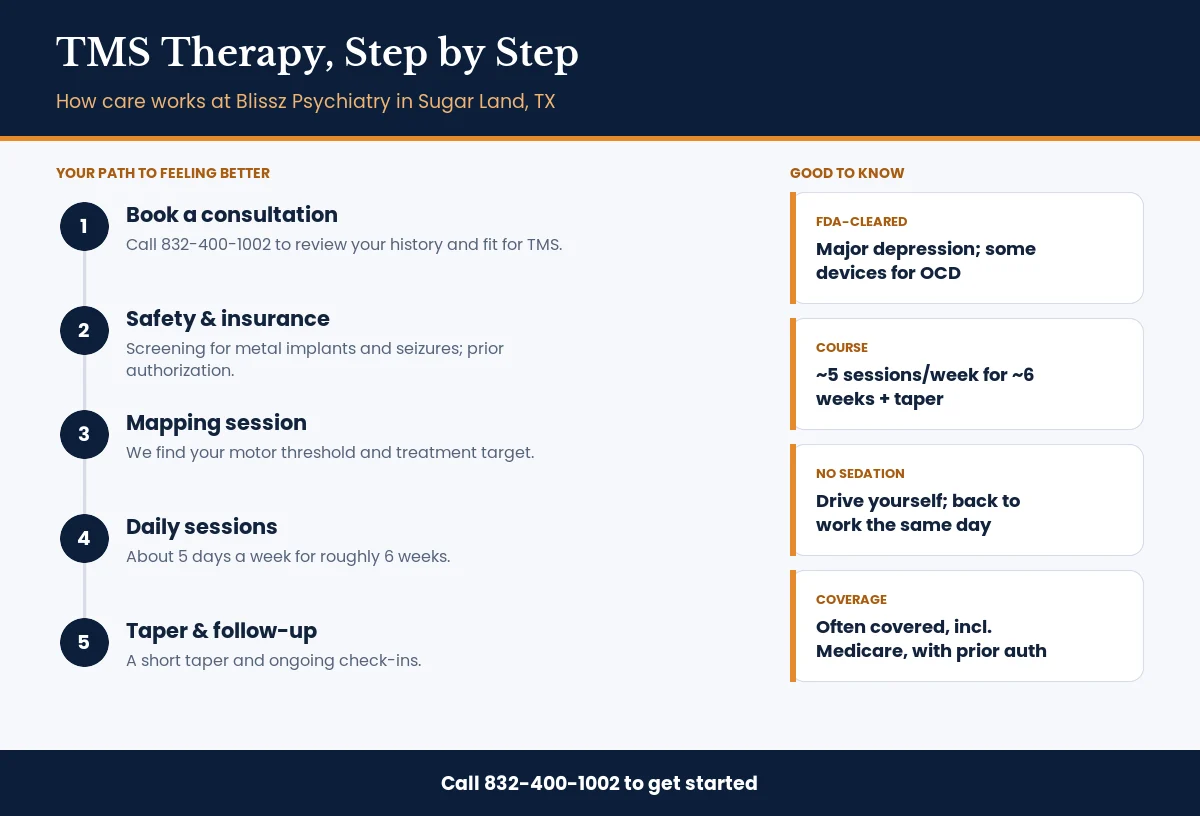
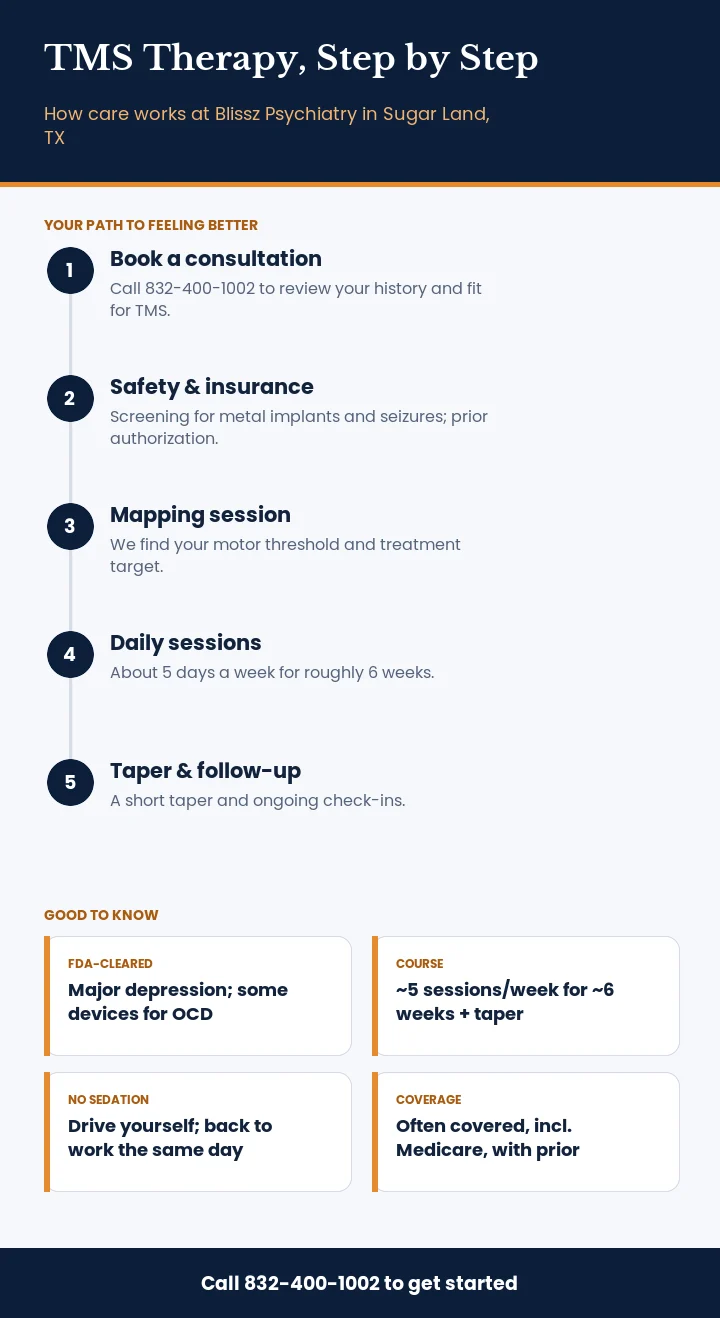
Before treatment, your provider reviews your diagnosis, medication history and medical background, completes safety screening and helps submit prior authorization to your insurance plan.
At your first session, we find your motor threshold, the amount of magnetic energy needed to activate the brain, and locate the treatment target. During each session you sit in a comfortable chair, awake and alert, while the coil delivers pulses that feel like tapping on the scalp. Depending on the protocol, sessions last from a few minutes to about 40 minutes. Afterward you can drive yourself and return to work or school.
Step by Step
Here is what to expect, step by step.
Book an evaluation at our Sugar Land office or by secure video anywhere in Texas. Most major insurance plans are accepted.
Many patients begin noticing changes in sleep, energy or mood within two to four weeks, though the timeline differs for each person. Improvements often become clearer toward the end of the course. Clinical studies, summarized by the American Psychiatric Association (APA) and the National Institute of Mental Health (NIMH), show that a meaningful share of people with treatment-resistant depression respond to TMS.

You can choose in-person visits at our Sugar Land office or HIPAA-compliant video visits from anywhere in Texas. Telehealth covers the same evaluation and follow-up care, as long as you are physically in Texas at the time of the visit.
Because TMS sessions happen in person several times a week, we schedule them to fit around work and school. Your consultation and follow-up medication visits can often be done by secure video.
Compare Options
How TMS fits alongside medication and other options.
| Treatment | How it works | Key considerations |
|---|---|---|
| TMS therapy | Magnetic pulses stimulate mood-regulating brain areas, in daily sessions for about six weeks | No sedation or systemic side effects; requires frequent office visits |
| Antidepressant medication | Daily medication that adjusts brain chemistry | Convenient; side effects such as weight or sexual changes for some people |
| Psychotherapy | Talk therapy such as CBT builds skills and insight | Effective alone or combined; takes weekly sessions |
| Esketamine (Spravato) | Nasal spray given under supervision in certified clinics | Fast-acting for some; requires monitoring after each dose |
| ECT | Brief electrical stimulation under anesthesia | Highly effective for severe depression; anesthesia and memory effects |
Insurance & Cost
Coverage is common for depression when criteria are met.
Medicare and many commercial plans cover TMS when these criteria are met, leaving a copay or coinsurance.
Our team gathers your treatment history, documents medical necessity and helps submit prior authorization, so you know your coverage before your first session.
Without insurance, a full course can cost several thousand dollars, so checking your benefits first matters. Call 832-400-1002 to start a coverage check.
Your Provider
Care at Blissz Psychiatry is led by Macbarbara Amaechi, PMHNP-BC, a board-certified psychiatric mental health nurse practitioner. Her clinical work centers on three things: thorough psychiatric evaluations, careful medication management and supportive therapy. She combines psychopharmacology with psychotherapy-informed care, explains options in plain language and makes treatment decisions with you, not for you.
Blissz Psychiatry holds a verified provider profile on Psychology Today, and the practice sees patients in person in Sugar Land, TX and Seattle, WA, and by secure video for patients located in Texas, Washington or Colorado.
Provider credentials

Insurance & Access
Plans and benefits vary. Call the number on your insurance card to confirm outpatient mental health coverage, or call us at 832-400-1002 and we will help you check. Self-pay is also available; ask our office for current rates.
Sugar Land office: 12930 Dairy Ashford Rd, Suite 701, Sugar Land, TX 77478, serving Sugar Land, Missouri City, Stafford, Richmond, Rosenberg, Katy and Houston. HIPAA-compliant video visits are available anywhere in Texas, Washington and Colorado.
Booking: Call 832-400-1002 or book online and choose the state you will be in during your visit. Ask our office about the next available new-patient appointment.
Payment: Due 24 hours before your visit; major credit and debit cards accepted.
In crisis? Call or text 988 (Suicide & Crisis Lifeline), or call 911. We are an outpatient practice and do not provide emergency care.
FAQ
We work with most major insurance plans, including Aetna, Blue Cross Blue Shield, UnitedHealthcare, Cigna, Anthem, Humana Military (TRICARE), Molina, AmeriHealth, Kaiser Permanente, Medicare and Medicaid. Coverage depends on your specific plan, deductible and network status. Call the member services number on your insurance card to confirm outpatient mental health benefits, or call our office at 832-400-1002 and we will help you check before your first visit. Self-pay is also available.
Most people describe TMS as a tapping or knocking sensation on the scalp. Some feel mild discomfort or a headache during the first sessions, which usually fades as treatment continues. You are awake the whole time, no anesthesia is needed, and you can drive yourself home and return to normal activities right away.
A standard course is usually around 30 to 36 sessions, given about five days a week for roughly six weeks, followed by a short taper. Session length depends on the protocol, from a few minutes to about 40 minutes. Your provider will recommend a schedule based on your history and response.
Yes. Medicare covers TMS for major depressive disorder when medical necessity criteria are met, which usually includes previous antidepressant trials that did not work or were not tolerated. Many commercial plans have similar criteria and require prior authorization. Our team helps gather the documentation your plan needs.
In most cases, yes. TMS is often used alongside medication and therapy. Your provider will review your current medications, because a few can affect seizure risk, and coordinate your overall treatment plan.
Yes. Evaluations and follow-up visits are available by HIPAA-compliant video when you are physically located in Texas at the time of the appointment. You will need a private space, a stable internet connection and a device with a camera. Prescriptions are sent electronically to your preferred pharmacy. Controlled medications follow additional federal and state rules, which our office will explain before your visit.
Availability changes week to week, so the fastest way to find the next open new-patient appointment is to call 832-400-1002 or check our online booking calendar for Texas. Video visits sometimes have earlier openings than in-person appointments. If you are in crisis, do not wait for a scheduled visit: call or text 988, call 911, or go to the nearest emergency room.
Have a question we did not answer here? Our office will walk you through it.
Location & Service Area
In-person visits take place at our office at 12930 Dairy Ashford Rd, Suite 701, Sugar Land, TX 77478, just off US-59 (I-69). It is a short drive from First Colony, Telfair, Greatwood, New Territory and Riverstone, and from Missouri City, Stafford, Richmond, Rosenberg, Katy and southwest Houston.
Prefer to stay home? HIPAA-compliant video visits are available anywhere in Texas, as long as you are physically in the state at the time of the appointment.
Blissz Psychiatry
12930 Dairy Ashford Rd, Suite 701
Sugar Land, TX 77478
Phone: 832-400-1002 · Fax: 832-410-3353
Related Care
Depression that has not responded to medication is still treatable. Call our office or book online, in person in Sugar Land or by secure video anywhere in Texas.
Now accepting new patients
Tell us how to reach you, then pick your location to choose a time that works.
Prefer to talk? Call 832-400-1002
Step 1 of 2 · Your details
Share a few details and we will help you book with a board-certified provider. It takes about a minute, and no medical details are needed.
Step 2 of 2 · Select your schedule
Please select your schedule: choose a time on the secure booking calendar for the state you will be in during your visit.
Questions or trouble booking? Call 832-400-1002. In crisis? Call or text 988.
Book online
Choose the state you will be in at the time of your visit.