
What if a thought you desperately do not want keeps returning? What if you know a door is locked but still feel compelled to check it again? What if washing your hands once does not feel like enough, even when you realize they are already clean? For someone living with obsessive-compulsive disorder, these experiences are not simply habits or moments of overthinking. They can become exhausting cycles that consume time, create intense anxiety, and make ordinary parts of life feel surprisingly difficult.
Table of Contents
- What Is Obsessive-Compulsive Disorder?
- What Are Obsessions and Compulsions?
- What Are the Symptoms of OCD?
- What Are Common OCD Themes?
- How Is OCD Different From Normal Habits or Worry?
- Can OCD Cause Mental Compulsions?
- What Causes OCD?
- How Is OCD Diagnosed?
- When Should You Seek Help for OCD?
- What Are the Treatment Options for OCD?
- What Is Exposure and Response Prevention (ERP) Therapy?
- Can Medication Help Treat OCD?
- How Can You Manage OCD in Everyday Life?
- Finding OCD Treatment in Sugar Land, TX
- Frequently Asked Questions About OCD
- Final Thoughts: Relief Is Possible
Important Note
Intrusive thoughts do not make you a bad person, and having a disturbing thought does not mean you want it to happen. OCD can make unwanted thoughts feel unusually important or threatening, leading people to perform rituals or repeatedly seek reassurance just to feel safe again. Understanding that cycle is an important first step toward breaking it. OCD is treatable, and professional support can help you regain more freedom in your everyday life.
What Is Obsessive-Compulsive Disorder?
Obsessive-compulsive disorder, commonly called OCD, is a mental health condition characterized by recurring, unwanted thoughts, urges, or mental images called obsessions and repetitive behaviors or mental acts called compulsions. These symptoms can become time-consuming, distressing, and disruptive to everyday functioning. [Source: National Institute of Mental Health]
OCD is often misunderstood because people sometimes use the word “OCD” to describe being organized, particular, or neat. Real OCD is much more than liking things arranged a certain way.
Someone with OCD may desperately want a thought to stop but find that the more they try to push it away, the more persistent it becomes. They may then perform a behavior or mental ritual to reduce the anxiety associated with the thought. The ritual may provide temporary relief, but the relief does not necessarily last. The thought or fear can return, creating another urge to perform the compulsion.
That cycle can become extremely tiring.
A person may spend minutes checking a lock before leaving home. Another may repeatedly wash their hands because they fear contamination. Someone else may silently repeat a phrase, count in a particular pattern, mentally review a conversation, or ask another person for reassurance again and again.
OCD symptoms can begin at different ages, although they commonly emerge during late childhood, adolescence, or young adulthood. Symptoms may fluctuate over time and often become more difficult to manage during periods of stress.
What Are Obsessions and Compulsions?
To understand OCD, it helps to understand the relationship between an obsession and a compulsion.
An obsession is an unwanted, recurring thought, urge, or mental image that causes distress. The thought may feel frightening, disgusting, morally disturbing, or simply impossible to ignore.
A compulsion is a repetitive behavior or mental act that a person feels driven to perform, often because they believe it will reduce anxiety, prevent something bad from happening, or make uncertainty feel more manageable.
For example, someone may have an intrusive fear that they left the stove on. They check the stove. For a moment, they feel relieved. Then doubt returns: “What if I looked too quickly?” They check again. The second check provides another brief sense of certainty, but eventually the doubt returns.
This is one reason OCD can become so persistent. The compulsion may temporarily reduce distress, unintentionally reinforcing the cycle.
Importantly, compulsions do not always make logical sense to the person performing them. Many people with OCD recognize that their behavior is excessive or that their feared outcome is unlikely, yet the emotional pressure to perform the ritual can still feel overwhelming.
What Are the Symptoms of OCD?
OCD symptoms vary widely from one person to another. Two people can both have OCD while experiencing completely different obsessions and compulsions.
Common obsessive symptoms include fears of contamination, fears of causing harm, unwanted sexual or religious thoughts, fears of making a mistake, concerns about losing control, intrusive doubts about relationships or decisions, and a strong need for symmetry or exactness.
Compulsive symptoms can include excessive washing or cleaning, repeated checking, counting, arranging, touching objects in a particular way, repeating words or phrases, asking for reassurance, avoiding triggering situations, or performing mental rituals.
Some people spend significant amounts of time reviewing events in their minds. They may repeatedly ask themselves whether they said something offensive, whether they accidentally hurt someone, whether a particular memory is accurate, or whether they truly meant something they thought.
The distress can be difficult to explain to someone who has never experienced it.
From the outside, checking a lock five times may look unnecessary. From inside the person's experience, however, the possibility of being wrong can feel impossible to tolerate.

What Are Common OCD Themes?
OCD can take many forms, and its themes can change throughout a person's life. The content of an obsession is not necessarily a reflection of the person's values or desires.
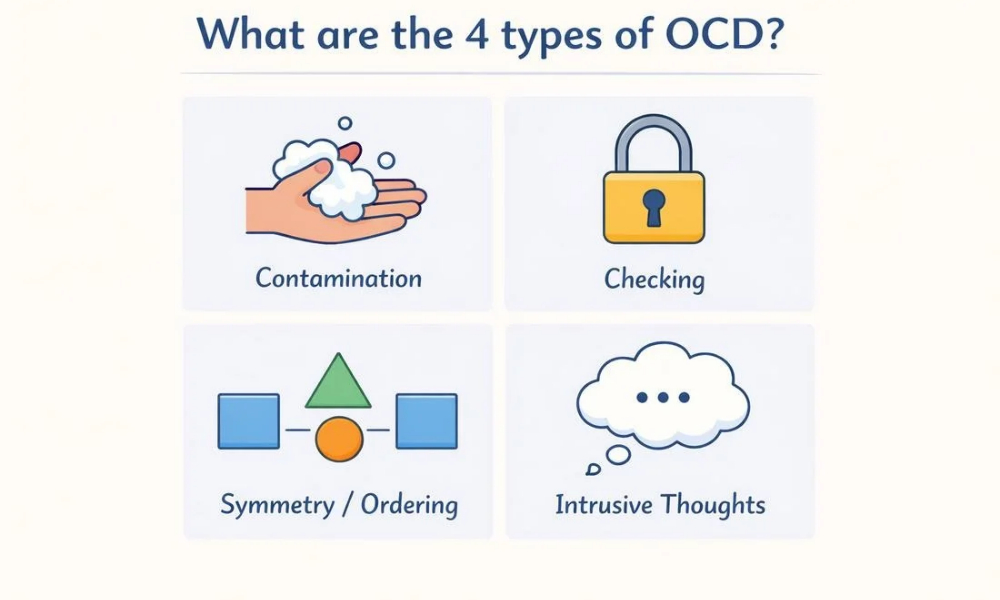
Contamination OCD may involve fears about germs, illness, chemicals, bodily fluids, or touching contaminated surfaces. Compulsions can include excessive handwashing, cleaning, showering, or avoiding objects and places believed to be contaminated.
Checking OCD may involve repeated concerns about whether a door is locked, an appliance is turned off, an important message was sent correctly, or a mistake was made. The person may check repeatedly even after receiving confirmation.
Harm-related OCD can involve intrusive fears about accidentally or intentionally harming oneself or another person. These thoughts can be particularly frightening because the person may interpret having the thought as evidence that they could act on it.
Symmetry or ordering-related OCD may involve an intense need for objects to be arranged in a particular way or for actions to be performed until they feel “just right.”
Intrusive taboo thoughts can involve unwanted sexual, religious, violent, or morally disturbing content. These thoughts can create tremendous shame, particularly when people mistakenly believe that having the thought means they secretly want it.
OCD can also involve relationship doubts, health-related fears, excessive responsibility, or repeated reassurance seeking. The specific theme matters less than the underlying pattern: intrusive distress followed by compulsive attempts to obtain certainty or relief.
How Is OCD Different From Normal Habits or Worry?
Everyone worries sometimes. Most people have intrusive thoughts occasionally. People also double-check things, prefer order, or repeat certain routines.
The difference is often found in the level of distress, loss of control, time involved, and impact on daily life.
Someone might check the front door once before leaving because they want to make sure it is locked. A person experiencing OCD may check it repeatedly, feel unable to leave despite knowing it is locked, return home to check again, or arrive late because of the ritual.
Someone might wash their hands after preparing raw meat. A person with contamination-related OCD may wash repeatedly until their skin becomes irritated or may avoid touching ordinary objects because of fears about contamination.
NIMH notes that people with OCD often have difficulty controlling their obsessions or compulsions, may spend substantial amounts of time dealing with them, experience temporary rather than lasting relief from compulsions, and experience significant interference with daily life.
That distinction is important because it prevents everyday preferences from being mislabeled as a psychiatric disorder while also recognizing when repetitive thoughts and behaviors have become genuinely disruptive.
Can OCD Cause Mental Compulsions?
Yes. OCD is not always visible.
Some people have compulsions that occur almost entirely inside their minds. They may mentally repeat words, review memories, analyze conversations, count, pray, compare possibilities, or repeatedly ask themselves questions in an attempt to reach certainty.
For example, someone may remember a conversation and suddenly wonder, “Did I accidentally offend that person?” They replay the conversation repeatedly, analyze every word, and try to determine exactly what the other person's facial expression meant.
They may eventually feel temporarily reassured, only for another doubt to appear: “But what if I missed something?”
This can become a mental loop that is difficult for other people to notice. The individual may look calm while internally spending hours trying to resolve an uncertainty that cannot realistically be resolved with absolute certainty.
Mental compulsions can be just as exhausting as physical rituals. Because they are less visible, they can also be harder for family members and even the person experiencing them to recognize as part of OCD.
Important Note
If your mind repeatedly asks “What if?” and you feel compelled to solve, check, analyze, or reassure yourself every time, that does not automatically mean you have OCD. Anxiety and other mental health conditions can produce intrusive thoughts as well. Try not to diagnose yourself based on one symptom. A professional evaluation can help determine whether the pattern is OCD, another condition, or a combination of concerns.
What Causes OCD?
There is no single explanation for why someone develops OCD. Research suggests that biological, genetic, psychological, and environmental factors may all contribute.
Having a family history of OCD or related mental health conditions may increase vulnerability, although genetics do not determine whether someone will develop OCD.
Researchers are also studying differences in brain circuitry, genetics, temperament, and environmental experiences that may contribute to OCD. NIMH notes that research has explored factors including genetics, biology, temperament, anxiety and depression in childhood, and childhood trauma, although the relationships between these factors and OCD are complex.
Stress can also influence symptom severity. Someone may have manageable symptoms for a period of time and then notice that their compulsions become much stronger during a stressful transition, relationship problem, work crisis, or other difficult period.
This does not mean stress is always the cause of OCD. Rather, stress can make existing symptoms more difficult to manage.
How Is OCD Diagnosed?
There is no single blood test or brain scan that can confirm OCD. Diagnosis is based primarily on a clinical evaluation of symptoms, their duration, severity, impact, and the broader mental and physical health picture.
During an evaluation, a mental health professional may ask about intrusive thoughts, repetitive behaviors, mental rituals, avoidance, reassurance seeking, anxiety, mood, sleep, medications, substance use, and how symptoms affect work, school, relationships, and daily responsibilities.
The provider may also explore whether another condition could better explain the symptoms or whether OCD is occurring alongside another condition. Anxiety and mood disorders commonly occur alongside OCD, which can sometimes make diagnosis more complicated.
People may feel embarrassed discussing certain obsessions. They may worry that a provider will judge them or misunderstand an intrusive thought as an expression of their character.
That is one reason honesty matters during an OCD evaluation. An intrusive thought is not the same thing as an intention. Describing the thought, how unwanted it feels, and what you do in response can help a clinician understand the pattern more accurately.
A psychiatric evaluation can help identify symptoms, consider possible diagnoses, and develop an individualized treatment plan.
When Should You Seek Help for OCD?
Consider seeking professional help when intrusive thoughts or repetitive behaviors are taking significant time, causing substantial distress, interfering with work or school, disrupting relationships, limiting where you go, or making everyday activities difficult.
You may also want an evaluation if you increasingly avoid ordinary situations because you fear triggering an obsession or if you find yourself repeatedly asking family members or friends for reassurance.
Another important sign is when you know that a ritual is taking over your life but feel unable to stop performing it.
OCD does not have to reach an extreme level before treatment becomes appropriate. Early support may help prevent symptoms from becoming increasingly entrenched.
If obsessive thoughts or compulsive behaviors are accompanied by thoughts of suicide, self-harm, or an immediate safety concern, seek urgent help. In the United States, call or text 988 for the Suicide & Crisis Lifeline, or call 911 in an immediate life-threatening emergency.
What Are the Treatment Options for OCD?
OCD is treatable. Treatment commonly involves psychotherapy, medication, or a combination of both. The right approach depends on symptom severity, individual circumstances, previous treatment, coexisting conditions, and personal preferences.
For many people, treatment focuses on changing the relationship between intrusive thoughts and compulsive responses. The goal is not necessarily to guarantee that unwanted thoughts will never occur again. Instead, treatment can help a person respond to those thoughts differently so they no longer control everyday decisions.
This distinction can be incredibly important.
A person with OCD may spend years trying to achieve complete certainty. Treatment may instead help them tolerate a reasonable amount of uncertainty without performing the ritual that OCD demands.
Psychotherapy can address the behavioral cycle directly, while medication may help reduce the intensity and frequency of symptoms for some people. When both are appropriate, they can complement one another.
What Is Exposure and Response Prevention (ERP) Therapy?
Exposure and response prevention, or ERP, is a specialized form of cognitive behavioral therapy that is widely used in OCD treatment.
ERP involves gradually facing situations or thoughts that trigger OCD-related anxiety while learning not to perform the usual compulsion. The process is structured and individualized rather than forcing someone into a frightening situation without preparation.
Imagine someone who repeatedly checks the door because they fear they left it unlocked. In an ERP-based approach, a therapist may help that person gradually practice leaving the door after a planned single check and then resist returning to check it again.
At first, anxiety may increase. That can feel uncomfortable. Over time, however, the person can learn that anxiety can rise and fall without requiring a ritual every time.
NIMH identifies ERP as a form of CBT that can effectively reduce compulsive behaviors. It typically involves gradual exposure to triggering situations while preventing the usual compulsive response.
ERP should be conducted appropriately and adapted to the person's symptoms. It is not simply a matter of “forcing yourself to stop being afraid.” The therapeutic process is designed to help people develop a different response to uncertainty, distress, and intrusive thoughts.
For some people, learning that they can experience anxiety without immediately obeying the compulsion can be a major turning point.
Can Medication Help Treat OCD?
Yes. Medication can be part of OCD treatment for some people, particularly when symptoms are persistent or significantly interfere with daily functioning.
Selective serotonin reuptake inhibitors, commonly called SSRIs, are among the medications used to treat OCD. Medication choices should be individualized based on symptoms, medical history, other medications, possible side effects, and the person's overall treatment goals.
OCD medication management can require patience. NIMH notes that antidepressant treatment for OCD may take several weeks before improvement becomes noticeable, and treatment for OCD may involve dosing considerations that differ from treatment for depression.
This is one reason follow-up care matters. A provider can monitor symptom changes, side effects, and overall functioning and make appropriate adjustments when necessary.
Medication should not be started, stopped, or changed without guidance from the prescribing clinician. If you experience concerning side effects or feel that your medication is not helping, discuss those concerns with your provider rather than changing the treatment on your own.
Blissz Psychiatry provides medication management and psychiatric care as part of its mental health services.
How Can You Manage OCD in Everyday Life?
Professional treatment is the foundation of OCD care, but everyday habits can also support emotional well-being and make treatment easier to follow.
Start by recognizing your triggers and patterns without judging yourself for having them. Keeping a simple record of situations that increase anxiety can help you and your provider understand when symptoms tend to become more intense.
Try to maintain a consistent sleep schedule. Poor sleep can make anxiety and emotional regulation more difficult. Regular physical activity can also support overall mental health, even if it starts with something as simple as walking.
Social support matters as well. OCD can become isolating, especially when a person feels embarrassed about their thoughts or begins avoiding situations that trigger symptoms. Trusted friends or family members can provide emotional support, although repeatedly providing reassurance can sometimes become part of the OCD cycle.
It can also help to avoid turning the search for certainty into another ritual. Reading endless articles, repeatedly searching symptoms online, asking the same question in different ways, or repeatedly analyzing whether you “really have OCD” can sometimes become part of the reassurance cycle.
The goal is not to monitor every thought perfectly. It is to gradually build a healthier relationship with uncertainty and intrusive thoughts.
Finding OCD Treatment in Sugar Land, TX
If you are searching for OCD treatment in Sugar Land, TX, finding care that recognizes both the emotional and behavioral sides of OCD can make an important difference.
Blissz Psychiatry & Healthcare LLC provides psychiatric care in Sugar Land with an emphasis on comprehensive evaluation, medication management, psychotherapy, and supportive mental health services. The practice's Sugar Land location is at 77 Sugar Creek Center Blvd, Suite 600, Sugar Land, TX 77478.
The practice's dedicated OCD treatment in Sugar Land page describes an individualized approach that may include psychiatric evaluation, medication management, psychotherapy, CBT, ERP, supportive approaches, and family education depending on the patient's needs.
Because OCD can overlap with anxiety, depression, and other mental health concerns, a comprehensive evaluation can help clarify what is happening rather than focusing on one symptom in isolation.
If you live in Sugar Land, Richmond, Missouri City, Stafford, or the surrounding Greater Houston area, professional psychiatric care can provide a structured place to discuss symptoms that may otherwise feel difficult to explain.
You Do Not Have to Let OCD Run Your Life
Intrusive thoughts and compulsive behaviors can feel overwhelming, but you do not have to navigate them alone. A professional evaluation can help you understand your symptoms and explore treatment options designed around your individual needs.
Book an Appointment with Blissz Psychiatry to take the next step toward understanding OCD and finding appropriate support.
Frequently Asked Questions About OCD
What is OCD in simple terms?
OCD is a mental health condition involving unwanted, recurring thoughts, urges, or images called obsessions and repetitive behaviors or mental acts called compulsions. These symptoms can become difficult to control, cause significant distress, and interfere with everyday life.
What are the most common symptoms of OCD?
Common symptoms include intrusive unwanted thoughts, excessive checking, repeated washing or cleaning, counting, arranging, reassurance seeking, avoidance, mental reviewing, repeating words or phrases, and other repetitive physical or mental rituals. The specific symptoms vary considerably between individuals.
Can OCD cause unwanted thoughts about harming someone?
OCD can involve unwanted intrusive thoughts about harm. Having an intrusive thought does not automatically mean that a person wants to act on it. A mental health professional can help distinguish intrusive OCD thoughts from other concerns by looking at the broader pattern, emotional response, intentions, behaviors, and functioning.
Is OCD just about being clean or organized?
No. Contamination and symmetry-related symptoms are only some possible OCD themes. OCD can involve checking, harm-related fears, intrusive sexual or religious thoughts, excessive responsibility, relationship doubts, reassurance seeking, mental rituals, and many other patterns.
Can you have OCD without compulsive behaviors?
Some people experience compulsions primarily as mental acts rather than obvious physical behaviors. They may repeatedly analyze, count, review memories, mentally reassure themselves, pray, or attempt to neutralize an intrusive thought. These mental rituals can still be time-consuming and distressing.
Can stress make OCD worse?
Yes. OCD symptoms can become more difficult to manage during periods of increased stress. However, stress is not necessarily the sole cause of OCD. Symptoms can fluctuate over time and may change in intensity or theme.
Is OCD curable?
OCD is generally considered a long-lasting condition, and there is no guaranteed cure. However, effective treatments can substantially reduce symptoms and help people participate more fully in everyday life. Treatment may include psychotherapy, medication, or both.
What is the best therapy for OCD?
Exposure and response prevention, or ERP, is a specialized form of cognitive behavioral therapy that is strongly supported for OCD. It helps people gradually face triggers while learning to resist compulsive responses. The appropriate therapy should be determined with a qualified mental health professional based on the individual's symptoms and needs.
Can medication help with OCD?
Yes. Medications, including certain antidepressants such as SSRIs, may be used to treat OCD. Medication can be used alone or alongside psychotherapy depending on the person's circumstances. A qualified healthcare professional should determine the appropriate medication and monitor treatment response.
When should I see a doctor about OCD symptoms?
Consider seeking professional help when intrusive thoughts or compulsive behaviors are taking significant time, causing distress, interfering with work or school, affecting relationships, restricting activities, or making everyday responsibilities difficult. You do not have to wait until symptoms become severe before seeking an evaluation.
Final Thoughts: Relief Is Possible
Living with OCD can be exhausting because the condition often asks for something that no person can realistically provide: absolute certainty.
You check the door because you want certainty. Then you check again because the first check did not feel completely certain. You replay the conversation because you want to know exactly what happened. You ask for reassurance because you want to know that everything is okay. For a moment, the anxiety falls. Then another “what if?” appears.
That cycle can make your world smaller.
But OCD does not have to determine where you go, what you do, who you talk to, or how you spend your day. Treatment can help you understand the cycle and gradually develop different ways of responding to intrusive thoughts and uncertainty.
There is no shame in seeking help for thoughts you did not choose or behaviors you feel unable to control. You are not your intrusive thoughts. You are not defined by your compulsions. And needing professional support does not mean you have failed to manage your own mind.
If you recognize yourself in these symptoms, consider talking with a qualified mental health professional. A comprehensive evaluation can help determine whether OCD may be involved and whether psychotherapy, medication management, or a combination of approaches may be appropriate.
If you are looking for OCD treatment in Sugar Land, TX, Blissz Psychiatry can provide a supportive setting to discuss your concerns and explore the next step in your care.
Medical Disclaimer: This article is for general educational purposes and does not replace professional medical advice, diagnosis, or treatment. OCD symptoms can overlap with anxiety disorders, depression, and other mental health conditions. If you are experiencing significant distress or symptoms that interfere with daily life, speak with a qualified healthcare professional for individualized guidance. If you are experiencing an immediate mental health emergency or believe you may harm yourself or someone else, call 911 or seek emergency medical care. In the United States, you can also call or text 988 for the Suicide & Crisis Lifeline.
0 Comments